Author: Yamuna Basnet
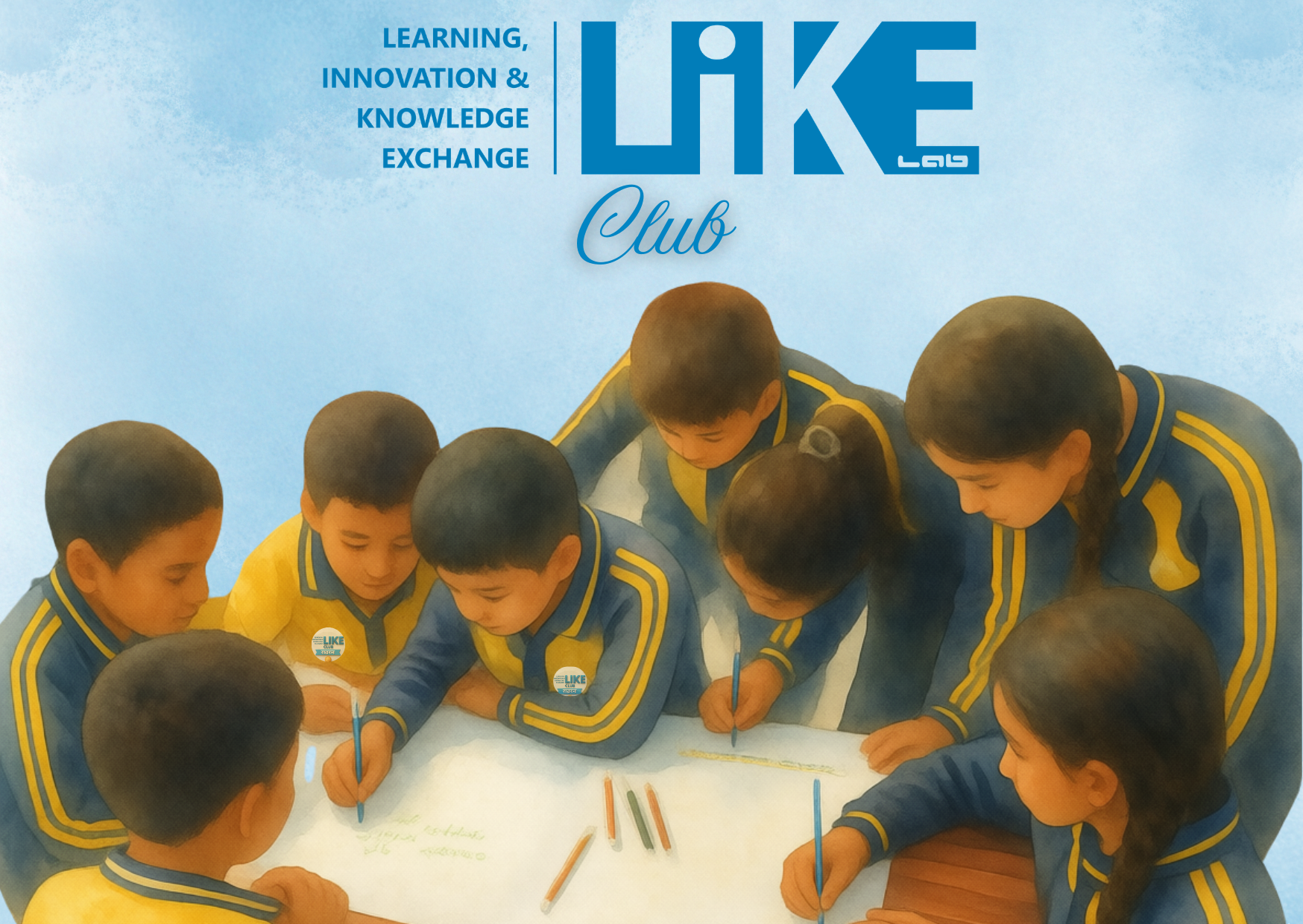
Last month, as part of our planned field trip, our team members visited 12 community schools in Bhojpur Municipality where LIKE Clubs are running, to sit and interact with the club members from grades 1 to 10. We brought along some chart papers and a bag of colorful signpens and asked them “What comes to your mind when someone says ‘LIKE Club’?” Or, if that felt too complicated, “What activities do you wish the club included more of?” They could answer however they wanted to: with a word, a sentence, or a drawing.
We were partly checking in on the activities conducted, their attendance; the usual things a field visit is meant to gather. But we were curious about the kind of answers that we would get. We asked two simple questions, but we did not get singular answers. Children took the same two words ‘LIKE Club’ and returned them to us shaped by whatever they had noticed, or needed, or were still working out how to say. In the Capability Approach, Understand, Interpret, Plan/Imagine and Think, is treated as the ability to use the senses, to imagine, think, and reason to form a conception of the good and engage in critical reflection. It is one thing to conduct a thorough literature review about those domains and write a few sentences down in a report, but it is an entirely different experience to walk inside a school and watch it happen in front of you, in the space of a couple of hours in the morning.
- “A beautiful club where we can play, be happy, and enjoy our life during school time.”
- “A place free of control for children.”
- “A club to exchange knowledge and learn new things.”
- “An organisation that teaches good behaviour.”
- “It helps us bring out our underlying feelings and lets it bloom. It helps us remove our fears. Leads us toward a disciplined and positive path.”
In some schools, the children said single words: Discipline. Cleanliness. Cooperation. Curiosity. Wish. Desire. Nice. We noticed some children tended to reach for something concrete and close at hand like fun, nice, cleanliness, with words that names a feeling without needing to justify it too deeply. Others built sentences that carried an argument inside them:“LIKE Club is a club that brings about change in mental and relational spheres,” or “It develops values of mediation and reconciliation in society.” Neither kind of answer is more true than the other, but reading them together, grade by grade, we could almost watch a capacity taking shape, i.e. the ability to hold an idea, turn it over, and put language around it in a way that is recognisably one’s own.
And given the option, not every child reached for words. Several curious hands drew small illustrations instead: of a house, a flower, a smiley face, a boy happily standing with a football, another one that is a near exact replication of the same, just with the words Messi written above, a cube, an elaborate, and near identical logo of LIKE Lab. It would be easy to read these as children who didn’t quite know how to answer, but we don’t necessarily think that’s what was happening. For a child who doesn’t yet have the vocabulary to explain something abstract, a drawing can do the same work a sentence does. A house can maybe hold the idea of safety. A flower can hold the idea of something beautiful. A boy standing with a ball can hold the idea of a place where he feels unguarded and free and maybe, feel one step closer to his football idol. One child drew the school compound with a flower placed beside it not because we asked for two things, but because that was, apparently, the fuller answer. What we learned is that thinking and imagining don’t always arrive as separate activities for a child. Often they are the same motion, just expressed with whatever tool happens to be in hand that day: a word, if the word is ready; a drawing, if it isn’t yet.
Interestingly, some of the answers chose to move past descriptions of the club, and focus more on the alternate question of what they wanted more of from the club instead:
“I want to be a football player through LIKE Club.” “I would like to dance more.” “I want to participate in more quiz competitions.” “I wish they conducted more sports activities.”
For these children to say “I wish there was more of this” requires first noticing what currently exists, then imagining something slightly different, then deciding they prefer it. That whole sequence of noticing, imagining, preferring is a small act of planning, even if the child would never call it that. It is also, in some ways, a child practicing the sense that their preferences are worth stating out loud to someone who might act on them. Read across the 12 schools, the recurring requests for more football, more dance, more quizzes stop looking like a simple wish list and start looking like children exercising a capability we happened to be asking about.
Another girl who had spoken about the club during her school’s morning assembly told us this:
“When I talked about LIKE Club in front of the line, I realised I have the ability to do it as well.”
She wasn’t really telling us about the club anymore, rather, she was telling us about something she had recently learned about herself. The difference between a child being told that they are capable and a child discovering it on their own terms, with no one having prompted the realisation, is something amazing. We can’t take credit for that moment, as a club can only offer the occasion, the small stage, and the reason to stand up; what she did with it was her own. Another child, when asked the same opening question, thoughtfully answered: “We think about 16 capabilities when someone says LIKE Club.”
Taken together, these answers don’t necessarily resolve into anything as neat as a single conclusion. Understanding, interpreting, planning, imagining, and thinking don’t show up as one fixed skill a child either has or doesn’t. They show up differently depending on age, on how confident a child feels with language that day, on whether a small sketch felt easier than a sentence. However, what seems true across the 12 schools we visited, is that LIKE club is giving children more chances to practice these things. While we went to Bhojpur to check on the club activities, what we returned with was the reminder that the thinking, the interpreting, and the imagining were already there in the children, long before we even arrived with our two questions.
Note: This blog is an output of the project titled ‘Promoting Gender Equality and Social Inclusion in Schools: Building on What Children Value and Aspire to Do and Be,’ implemented by LIKE Lab, Kathmandu University School of Arts, with support from the Global Partnership for Education and Innovation Exchange (GPE KIX) and the International Development Research Centre (IDRC).
Disclaimer: The views and opinions expressed herein do not necessarily represent those of the International Development Research Centre (IDRC) or its Board of Governors.