Authors: Yamuna Basnet, Binayak Krishna Thapa
In the past year and a half, as part of our ongoing research, we collected data from 13 community schools in Bhojpur Municipality through various methods. These included a 26 focus group discussions and a subsequent baseline survey that aimed to understand the status of Gender Equality and Social Inclusion (GESI) in selected public schools of Bhojpur Municipality before the introduction of our project interventions. During one of those processes, we asked them a simple question: What does education mean in your lives? In one group, boys put it simply: education is “of two types: one that you have due to your interest, and one that you get out of pressure”. In another group, girls said that education “frees us from darkness and leads to success” and that without it “our future is bleak”. Even though these are not lines from a policy document, these children were describing something of an idea that development economists and philosophers have spent decades trying to put into formal language: that education is not simply a service handed to a child, but a capability, a freedom that shapes who a person is able to become. This blog attempts to sit with both of those things at once i.e., the theory behind that idea, and what children in Bhojpur actually said and showed us when we asked them about it.
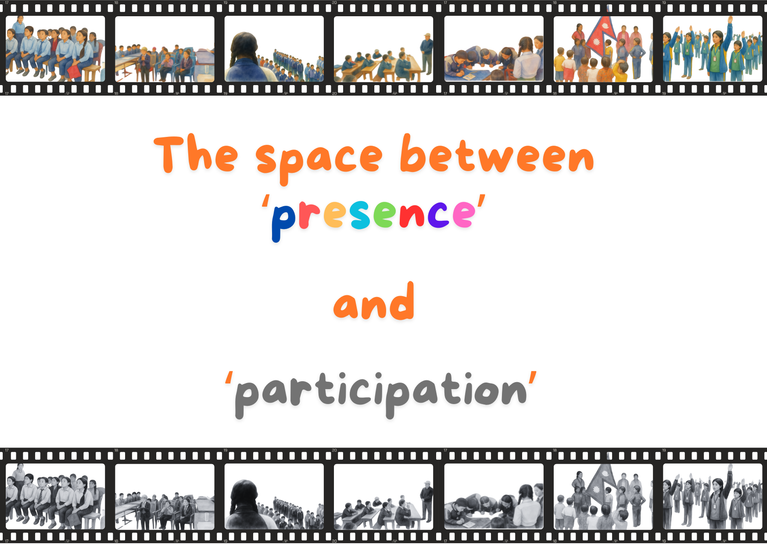
What is the difference between being present in school and actually learning?
For a long time, education has mostly been measured by inputs and outputs: enrollment rates, attendance, grade progression, literary scores. These numbers are undoubtedly important, but Amartya Sen’s Capability Approach asks us a thought provoking question that asks us to look beyond that: even when a child is sitting in a classroom every day, is she actually free to learn, to take part, and to become who she wants to become? Or is she simply present there for the sake of being present? In our baseline survey, most children in Bhojpur report strong basic capabilities: they can read, write, learn and finish their homework. But when we look a little closer, the gaps appear between having a capability, achieving an outcome, having a real choice, and then actually being able to act on that choice. A child might be able to read well, but whether he or she gets to learn from a teacher, a friend, or a parent depends on relationships and circumstances she has little control over. Capability, in that sense, isn’t something that simply lives inside a child’s head. It either gets realized, or it doesn’t, depending on who is around him or her and whether their surroundings lets them draw on that support.
What makes education a basic capability for every child?
To begin with, both the pioneers of the Capability Approach, Amartya Sen and Martha Nussbaum, value education as a basic opportunity. Sen identifies education as one of “a relatively small number of centrally important beings and doings” that are crucial to well-being, while Nussbaum, through her work on higher education, explains the importance of education for women’s empowerment and a healthy democratic society through strong public education. Although both suggestions come from different stances, both of them agree on and confirm the importance of education as a basic capability that enhances other capabilities.
The opportunity of being and becoming educated and receiving education breeds in children the ability to do valuable educational acts and even reach valuable educational states of being and becoming. This we borrow from Sen’s definition of a capability in general and fit it for our use to explain education through the children’s well-being and capability approach lens. In Nepal’s rural settings, education is offered to all students of school-going age through the community schools located in the vicinity of their residence. Ideally, children in community schools should be able to make choices that matter to them for a valuable school life; however, this is not the case because of different quality and resource constraints and barriers in the education system.
Education also plays a different role in different contexts: the instrumental social role, the instrumental process role, the empowering and distributive role, and the redistributive role. Having stated this, we have a few assumptions here. The first is that children are real social actors endowed with the full range of human capabilities. Second, we need to consider children as capable agents and promote the active participation of children in society. Third, in the context of developing countries like Nepal, the public education system is the only practical formal mechanism we have for guaranteeing that all children get reasonable access to education.
Thus, education offers a child a life with the freedom to make real life choices, including comprehensive education outcomes (reading, writing skills, ability to calculate, imagine, and think), which encompass both the opportunity and process of capacity, skills, and knowledge formation. But, if a person lacks or misses this opportunity either through informal or formal schooling, they will be at a disadvantage and even harm their present and future well-being. Moreover, the opportunity of accessing education, and hence having the capability to be educated, can be considered as fundamental and foundational things that help achieve other opportunities. The lack of this, or to say, being deprived of these fundamentals, hinders the holistic well-being of the person experiencing the absence of education. This is also part of why education is treated as basic in the capability literature: its absence causes harm that is hard, sometimes impossible, to undo later. Therefore, what happens, or doesn’t happen, in a child’s early relationship with learning shapes what becomes possible for them long after they’ve left the classroom.
How do boys and girls in Bhojpur view their educational futures?
One of the things that stayed with us most from the discussions was what came up around children’s sense of the future. Children, especially girls, spoke with real conviction about education as a path to a better life. “If we study hard, we can become successful people in life”, one group told us. Another described education as necessary “for the development of our country, Nepal”. This kind of language runs through the conversations again and again: becoming a doctor, an engineer, earning a degree, being able to stay near family instead of having to migrate abroad for work. While children’s belief that education will shape their future is strong, their sense that they have the freedom to decide how it shapes that future is noticeably weaker.
The boys phrased education mostly as a process: teaching, learning, listening, concentrating, and the discipline of finishing homework on time. There was a strong thread of give and take in what they said like sharing knowledge with friends, and teaching each other what they know. The girls, interestingly, leaned more toward outcome and direction: success, ambition, the specific career path education might lead to (doctor, engineer), and a very striking way of describing education as something that “frees us from darkness”. Some also brought up something we hadn’t exactly expected, that people can be educated “at any age”, pointing to elderly people in their community sitting for SEE exams. It’s a more expansive idea that counts as being educated, and one that isn’t bound to childhood at all.
When Sen first argued that education belonged among a handful of capabilities most central to a person’s well-being, he wasn’t only making a point about human capital or future earnings, he was making a claim about the dignity, since being able to get an education is tied to a person’s ability to take part as an equal in their community, to reason about their own life, and to hold what he called the social bases of self respect. Therefore, when a boy says education is “important for every kind of work”, or a girl says it “provides opportunities to learn and succeed”, they are describing something that is both valuable in itself, a kind of dignity and something that is useful for the life ahead of them, to stay near family rather than leaving them. This may also be part of what separates a capability view of education from narrower ideas that treat schooling mainly as a way of producing future workers. As evidenced from our ongoing research, the children’s own words make that distinction feel almost obvious, without us even needing to argue for it.
Note: This blog is an output of the project titled ‘Promoting Gender Equality and Social Inclusion in Schools: Building on What Children Value and Aspire to Do and Be,’ implemented by LIKE Lab, Kathmandu University School of Arts, with support from the Global Partnership for Education and Innovation Exchange (GPE KIX) and the International Development Research Centre (IDRC).
Disclaimer: The views and opinions expressed herein do not necessarily represent those of the International Development Research Centre (IDRC) or its Board of Governors.