Authors: Yamuna Basnet, Binayak Krishna Thapa
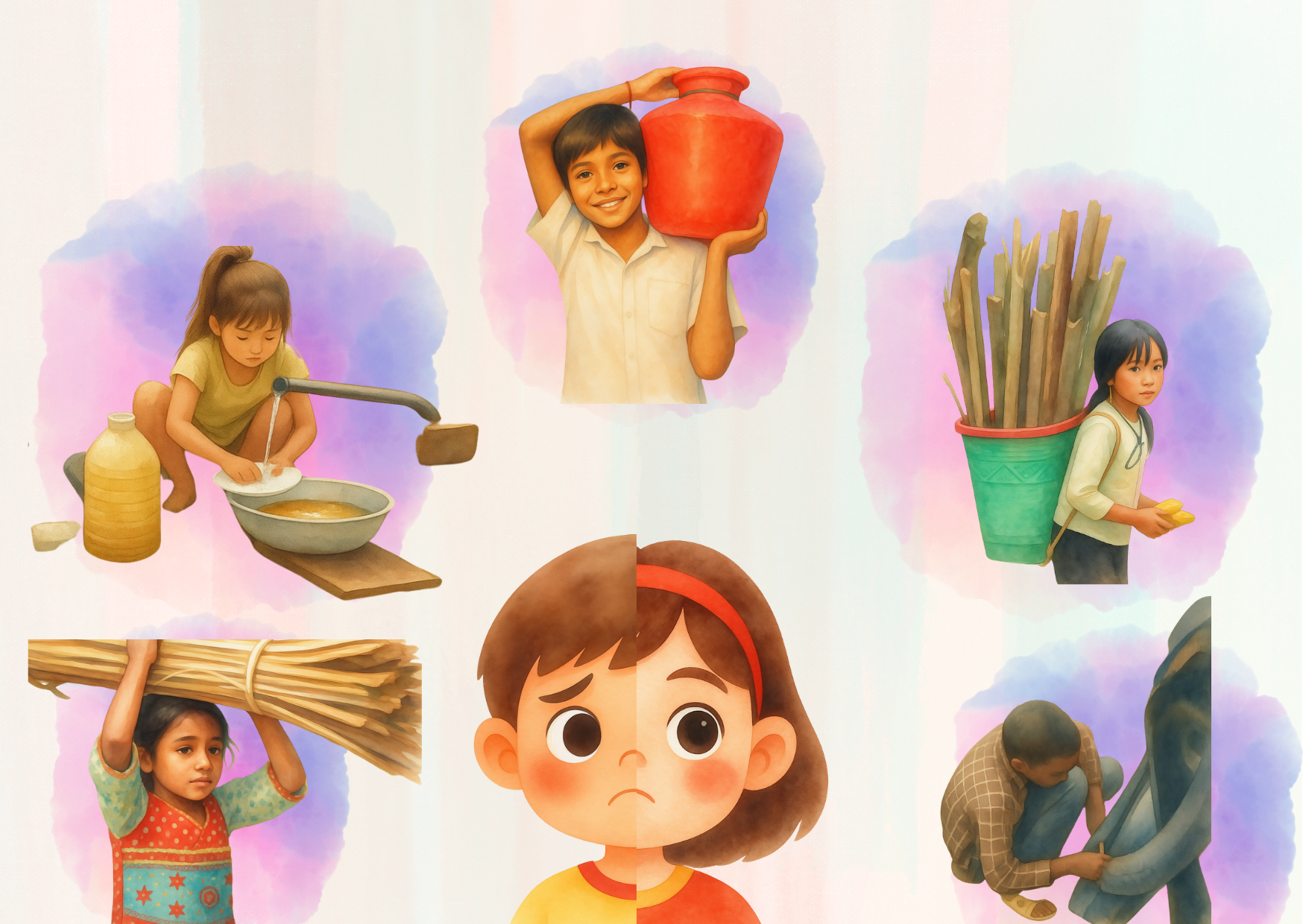
Making a living in the hills is challenging enough, and it is even more daunting for people surviving at the margins. Life demands more physical work as livelihood opportunities are limited, and for families at the lower end of the income ladder, day to day activities are laborious and the returns, subsistent. For a typical farmer, running a household demands a lot of physical work per day, and it requires each household member to contribute in some way or the other. It could be anything like fetching water, gathering firewood from the forest, cutting grass for livestock, or taking the cattle out to graze.
Given this lifestyle, the adults of the hills are dependent on the younger adolescents, and even children, to carry out some activities or the other while maintaining and managing a household. Children in the hills, as early as their age permits, are taught, trained and even instructed to do household chores. How much time these children have for themselves, and for their personal development, leisure, play and learning is always a question for children’s researchers. And how much of these household activities done by the children belonging to poor hill households can impact on their well-being and becoming is another question to be answered. As long as this has no negative effect on their health and personal development, and does not disturb their school lives, children engaging in these activities can be regarded as a good thing. An assumption held here is that, in the long run, the work they do now will contribute to their personal development and to the well-being of their family.
As children’s researchers, as much as our perspectives on child work and labor differ, so do the work arrangements for girls in comparison with the boys in these communities. While some advocate for an absolute ban on work for school-aged children, others argue that age-appropriate chores are acceptable so long as they do not jeopardize education or health. Given this context, this blog details how students in the hills pursue an education while helping sustain their households. It offers a case of school going children, their daily lived experiences of education with household responsibilities, and how hill society looks at the issue of child work, and child labor.
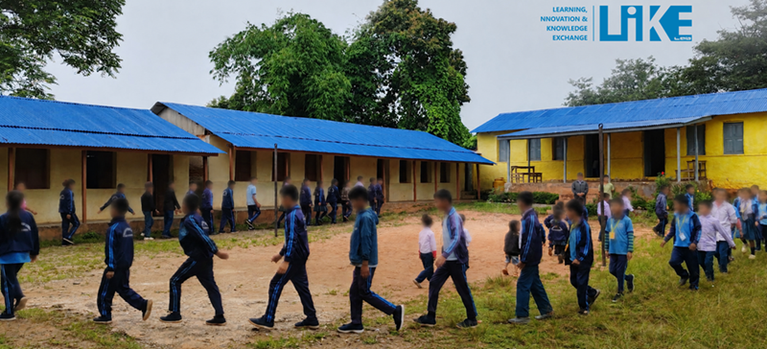
When we walk down the paved hills of Bhojpur, Nepal, every so often, we will pass a signboard by a rest stop proclaiming a child’s right to education and warning of the penalties for child labour. While Nepali law is unambiguous on its stance on this topic, reality is less so. Children from impoverished backgrounds are still commonly sent to live with better off relatives in the bazaar area, where they take on household labour in exchange for room, board, and the chance to attend the nearest community school. It is neither quite protection, nor quite exploitation in the traditional sense. And for children, freedom from exploitation is something that is closely connected with authority over one of their most limited resources, i.e, time, and it is not something as simple as ‘doing labour’ vs. ‘doing no labour’.
In our series of Focus Group Discussions conducted ahead of our baseline survey, children in Bhojpur described this freedom in very practical terms. Boys spoke about not being pushed beyond their physical limits, avoiding labour done for outside income, and being shielded from physical abuse. However, they did not reject work outright. Washing clothes, preparing meals, tending a garden, or helping in the fields were treated as ordinary, even healthy parts of daily life, as long as what was asked of them matched their age and strength. Girls echoed this sentiment, but placed a higher emphasis on schooling like studying hard, attending class consistently, and holding on to time for play. Like the boys, they normalized age appropriate chores as a legitimate way of contributing to the household. Across both groups, the line children drew was consistent. Freedom from exploitation did not mean exemption from effort. Instead, it more so meant a firm boundary between constructive family contribution and labour that comes at the cost of education, health or well-being. They also didn’t see this boundary as something only they had to hold alone. They named parents, community members, and law enforcement as the people who were supposed to help hold it too.
The findings from the baseline survey back up these qualitative accounts. Children overwhelmingly report being able to attend school without being pulled away from work or household chores, and they describe having real room to prioritize learning over labour, which is reflected in steadier attendance and more hours spent with books than with chores. A child doing household labour for relatives in exchange for schooling may appear, on paper, as exercising the very balance the children described as healthy. However, whether it functions that way in practice depends on details a signboard cannot capture, like how much labour is asked of the child, whether school still comes first, whether they get punished when they’re perceived as ‘slacking off their duties’, and whether anyone is actually checking and willing to speak up when they witness something unacceptable.
When seen through a theoretical lens, this balance touches upon the topic of child development more broadly. Children have long been cast in human rights literature as “human becomings”, or incomplete people whose present experience matters mainly as preparation for a future adult self. Author Noam Peleg pushes back on this by applying the Capability Approach to children’s rights, arguing that development is really about expanding a child’s real opportunities and agency now, not later. Looking at it this way, a child balancing chores with schooling isn’t just being readied for adulthood, they are in reality already exercising the capacity to shape their own life.
Another thing that the survey touches upon is the children having time to study and actually using it. While they report slightly more freedom to prioritize study, they get to exercise it less in practice. The gap isn’t incredibly large, however, it points to some real domestic tasks that, even when culturally valued and developmentally appropriate, still compete for a child’s time and cognitive energy. A child can be enrolled in school, be technically free to attend it, and still arrive there worn out by the labour that paid for that privilege. The survey’s findings on legal rights and safety also add an interesting dimension to this topic. In the FGDs, children spoke clearly about resisting harmful labour and knowing when to involve the police or local authorities. The survey results confirmed that children generally feel aware of their rights and are capable of acting if those rights are threatened.
From a capability perspective, this is the bridge between knowing and agency. Knowing you have rights creates the possibility of acting on them whereas having the freedom to act is what turns that possibility into real control over your own life. This is also where a long running debate in international development becomes concrete. Humanitarian frameworks have historically treated vulnerable children as passive victims awaiting adult rescue. Ruiz-Casares et al. argue instead that effective child protection is impossible without active child participation, when children can recognize exploitation, understand their rights, and feel able to report abuse. Their very participation strengthens the protective system around them rather than when they’re sitting outside it. When we look at the child staying with relatives in the bazaar, whether that child experiences protection or quiet exploitation may hinge less on the arrangement itself than on whether they have the knowledge and standing to say when it has gone too far and whether someone is listening if they do.
The qualitative and quantitative findings from our study point to one clear message: children really do value contributing to their families, but they also instinctively expect the expectations put upon them to have limits. Helping at home is a normal, even healthy part of growing up, but being denied an education, or pushed into labour that harms them, is not. Freeing children from exploitation takes more than keeping them out of workplaces or putting up signboards along a road. It means safeguarding their time, expanding their real opportunities, and respecting their agency so that every child, whether at home with their own parents or living with relatives in exchange for their keep, has the safety, knowledge, and freedom to learn, play and grow on their own terms.
Note: This blog is an output of the project titled ‘Promoting Gender Equality and Social Inclusion in Schools: Building on What Children Value and Aspire to Do and Be,’ implemented by LIKE Lab, Kathmandu University School of Arts, with support from the Global Partnership for Education and Innovation Exchange (GPE KIX) and the International Development Research Centre (IDRC).
Disclaimer: The views and opinions expressed herein do not necessarily represent those of the International Development Research Centre (IDRC) or its Board of Governors.