Author: Utkrishta Sharma
When we talk about children’s education, the focus often falls on classroom learning, academic performance, grades, examinations, and attendance. While these things matter, children’s school experience is also shaped by whether they have opportunities to express themselves, explore their interests, and participate. In today’s education system, children are still often seen mainly as learners rather than active participants, with adults primarily steering their learning.
To bridge the gap created by limited opportunities for children to exercise agency and actively shape their learning, child clubs can serve as a mechanism to create more space for children to exercise their right to participate. Drawing on the LIKE Club experience in community schools in Bhojpur Municipality, Koshi Province, Nepal, this blog explores why these spaces matter and why scaling them deserves consideration.
What Are Child Clubs in Nepal?
Child clubs, also known as Bal Clubs (बाल क्लब) or Bal Adhikar Manch (बाल अधिकार मञ्च) in the Nepali language, are a form of child-led group or organization that provides children with opportunities to participate, express their views, collaborate with peers, explore their interests, develop their abilities, and speak up for their rights. Nepal has recognized children’s participation for more than three and a half decades since ratifying the United Nations Convention on the Rights of the Child (UNCRC) in 1990. This commitment is also reflected in the Constitution of Nepal (2015) and the Act Relating to Children (2018), which recognize children’s rights and participation.
Since then, child clubs have grown as a platform for promoting children’s participation, with support from government agencies, development organizations, and civil society across the country. The National Strategy on Child-Friendly Local Governance (CFLG), introduced in 2011, further strengthened child participation in local governance. Yet, having more clubs does not necessarily mean children are experiencing meaningful participation. This raises an important question: Are we simply increasing the number of child clubs, or are we creating spaces where children can participate in ways that matter to them? The experience of LIKE clubs in Bhojpur Municipality provides some insights into exploring this question.
What is the LIKE Club Initiative?
LIKE Club is a student-led child club model that operates within schools and aims to become part of the regular school structure. Unlike traditional child clubs, which are often adult-led, it aims to give children greater opportunities to exercise their rights to participation, make decisions, develop leadership and creativity, exchange ideas, and take collective action on issues that matter to them. The model is informed by Amartya Sen’s Capability Approach and builds on 16 well-being capabilities identified through participatory research with children. These capabilities guide 19 structured activities in the LIKE Club Activity Booklet, including public speaking, debates, quizzes, sports, and creative exercises. Gender Equality and Social Inclusion (GESI) principles are integrated into the club’s activities and implementation to ensure that children of all abilities and backgrounds can participate, contribute, and lead.
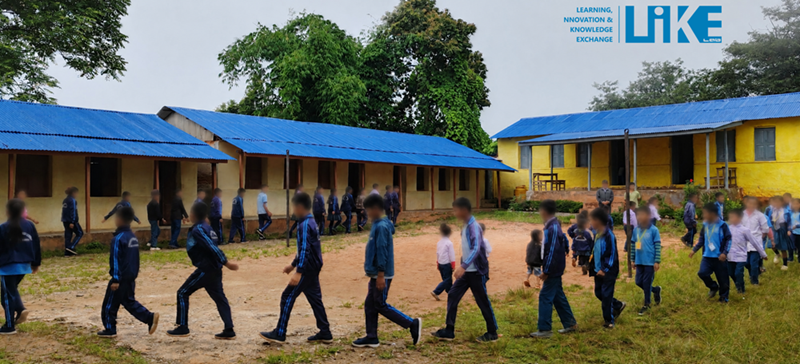
The initiative has been introduced in 13 community schools in Bhojpur Municipality, Koshi Province, Nepal, by the Learning, Innovation, and Knowledge Exchange (LIKE) Lab, a social science research lab based at Kathmandu University School of Arts. It is part of a 36-month cross-country research-for-development project titled “Promoting Gender Equality and Social Inclusion in Schools: Building on What Children Value and Aspire to Do and Be.” Supported by the Global Partnership for Education Knowledge and Innovation Exchange (GPE KIX) and the International Development Research Centre (IDRC), the project is led by LIKE Lab as the consortium lead. It is also being implemented in Bangladesh through RDRS Bangladesh and in Bhutan through Samtse College of Education, Royal University of Bhutan. In Nepal, LIKE Lab aims to expand the initiative to 30 additional community schools by February 2027, reaching 43 schools in Bhojpur Municipality.
What Does LIKE Club Mean to Children?
During our recent field visit to 12 community schools where LIKE clubs had been operating for more than six months, we interacted with club members and asked them two simple questions: “What comes to your mind when you hear LIKE Club?” and “What activities do you wish the club included more of?” We wanted to understand how children themselves were experiencing the club and developing their understanding of what a children’s club can be and how it can function. We have shared the responses of the club members in more detail in an earlier blog, which can be accessed through this link.
Their responses reflected the different ways children experienced and understood the club. They described it as a space to play, enjoy time with their friends, learn, cooperate, and share ideas. One child described it as a place to “exchange knowledge,” while another called it a place “free of control for children.” Their responses to what they wanted more of from the LIKE club were equally varied and included the wish for the inclusion of club activities such as dance, quizzes, and sports. One child expressed, “I want to be a football player through the LIKE club.” Together, these responses highlighted the range of interests, aspirations, and experiences that children bring to the club and the importance of giving them space to shape what the club can offer. For us, as project implementers, these responses offered a glimpse into what a child club can mean in a child’s everyday life and what children value in these spaces. This diversity is important when thinking about scaling, as clubs should be able to respond to the interests, needs, and contexts of children in each school. Scaling, therefore, should not mean replicating the same activities everywhere but creating spaces that remain meaningful and relevant to children in their own contexts.
Why Do Child Clubs Matter, and Why Scale Them?
Children’s experiences with the LIKE Club shed light on the value of child clubs in schools. Together with our experience implementing the initiative, these insights inform five reasons to support their wider adoption.
1. Creating opportunities for every child to participate and contribute: Child clubs offer children opportunities to explore their interests, share ideas, and contribute to school life beyond the classroom. Through a range of activities, children with different strengths and abilities can discover what they enjoy, build confidence, and participate in ways that reflect their interests. Scaling the LIKE club model can help more children access these opportunities while allowing each club to respond to the needs and interests of the club members.
2. Strengthening children’s agency: Child clubs give children opportunities to make choices, take initiative, and have a say in decisions that affect them. Through the LIKE club, we saw children getting involved in organizing club activities and making decisions about how and what activities they can conduct through the club at their school. Thus, scaling the LIKE club model to more schools could give more children similar opportunities to take initiative, make decisions, and participate actively in their school lives.
3. Making space for individuality: Children have different interests and aspirations, as we heard during our conversations with club members. While some children wanted more sports-related activities for the club to organize, others were interested in activities such as dance and quizzes. Child clubs can make room for these differences, allowing children to explore what they enjoy and express themselves in their own ways. Therefore, scaling the club model can potentially help more schools create spaces that reflect what children value.
4. Building capabilities: Some skills develop best when children have the chance to put them into practice. Child clubs provide space for children to share their ideas, work with others, take responsibility, and try new things. By expanding the LIKE Club model, more children could have these experiences and developed capabilities to support them both in school and beyond their school life.
5. Promoting gender equality and social inclusion: Child clubs can help children learn to respect differences, value one another’s perspectives, and participate on equal terms regardless of gender, ability, or background. Through shared activities and decision-making, children can practice inclusion and cooperation in their everyday school lives. Scaling the LIKE club initiative can help more schools create spaces where every child feels valued and has the opportunity to participate.
For these reasons, scaling child clubs should not be seen simply as expanding or replicating the same model from one school to another. It should be understood as an ongoing process of adapting and strengthening the model so it can take root in different school contexts, remain sustainable, and continue to benefit children.
Note: This blog is an output of the project titled ‘Promoting Gender Equality and Social Inclusion in Schools: Building on What Children Value and Aspire to Do and Be,’ implemented by LIKE Lab, Kathmandu University School of Arts (KUSoA), with support from the Global Partnership for Education and Innovation Exchange (GPE KIX) and the International Development Research Centre (IDRC).
Disclaimer: The views and opinions expressed herein do not necessarily represent those of the International Development Research Centre (IDRC) or its Board of Governors.
References:
- Basnet, Y. (2026, September 2). What LIKE Clubs mean to children in Bhojpur: Reflections on thinking, imagining, and making sense. LIKE.
- Constitution of Nepal. (2015). Constitution of Nepal. Constituent Assembly Secretariat.
- Dahal, B. P. (2014). Child participation in schools of Nepal: Role and contribution of child clubs [Doctoral dissertation].
- Government of Nepal, National Child Rights Council. (2018). Happy Nepali, prosperous Nepal: Concerns of all to the rights of children—State of children in Nepal 2018 (Synopsis). http://childrights.gov.np/_uploads/publication/4/b68fe81218d02913df7f85393931a056.pdf
- Thapa, B. K., & Basnet, Y. (2026). Baseline report: Promoting gender equality and social inclusion in schools: Building on what children value and aspire to do and be. Learning, Innovation, and Knowledge Exchange Lab, Kathmandu University.