Authors: Yamuna Basnet, Binayak Krishna Thapa
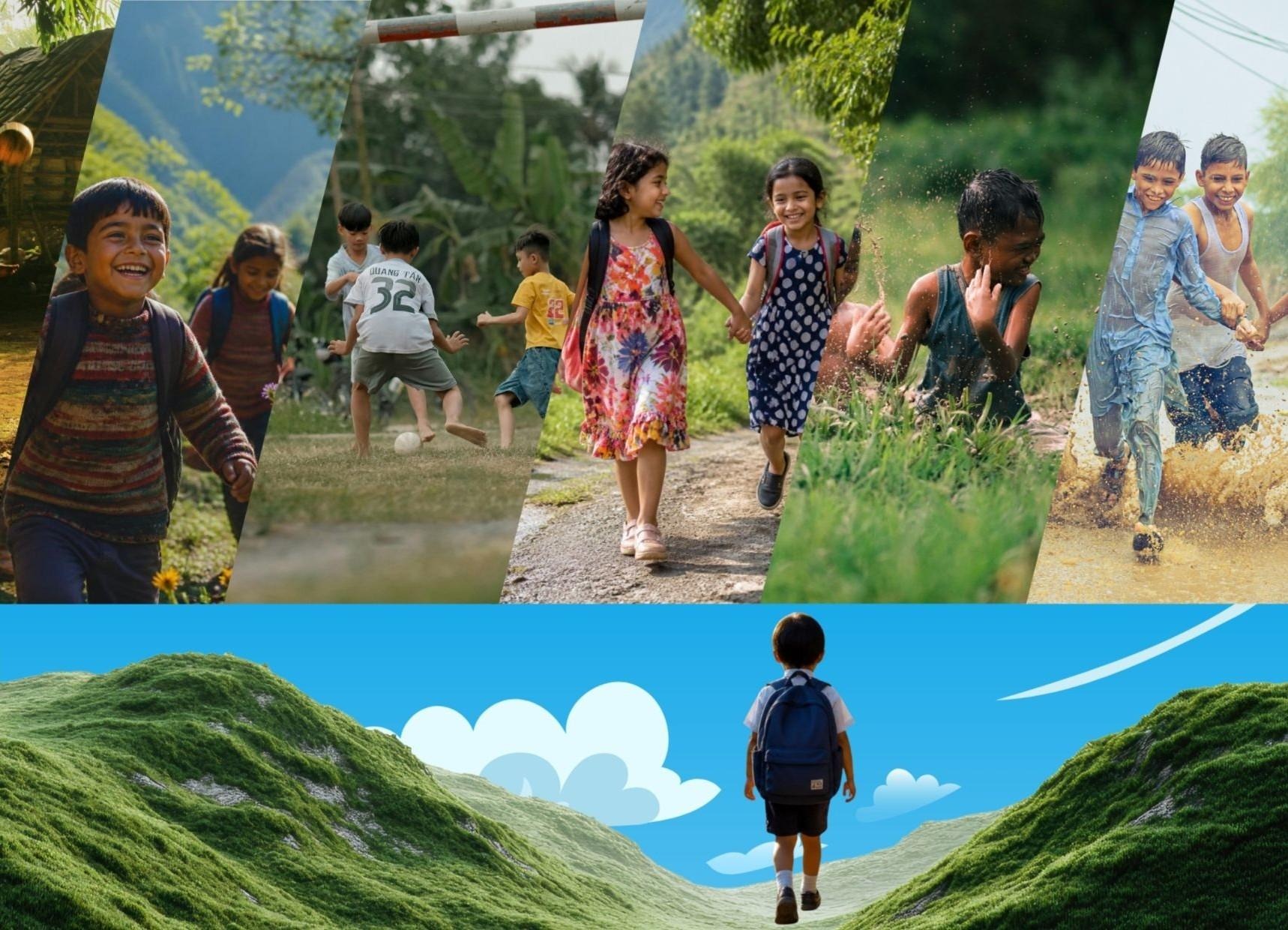
In the mountains and hills of Nepal, access to education depends on one general factor: the distance between a student’s residence and the community school. On average, a student of school-going age is required to walk between 15 minutes to an hour and a half to attend school, and it is a set routine for them to walk this distance to and from school every single day. This walk to school is where many social and economic dynamics play out, and this walk is precisely how we connect to the idea of children being or not being mobile in their daily student lives at play.
It is in this walk that they stride down a footpath, along a ridge, past a shrine or a shop, sometimes with a sibling or friends, and sometimes alone. It probably happens every morning without much thought, only because it’s happened so many times before. However, what’s interesting to us as children’s researchers is that this same confidence doesn’t seem to carry over once the school day is over. A child who can walk that same path alone at seven in the morning may still need their parents’ permission to walk somewhere else entirely different in the afternoon: a friend’s house, an open field, or maybe nowhere in particular.
When we conducted a series of focus group discussions with students in community schools of Bhojpur, boys described mobility in terms of habit and responsibility. Several talked about walking regularly and on time, and doing physical exercise. At the same time, there was a clear sense of limits: going out only when needed, not going far from home, doing what your parents say. Even when they mentioned something more adventurous, like visiting a different village to see what it was like, it still came framed as purposeful something with a reason attached, and not an open wandering done just for the sake of it. There were also small, practical details that stood out to us: crossing the road at a zebra crossing, not fighting on the street while walking, helping a friend who runs into trouble on the road. And there was room for enjoyment too, like playing on a swing, on an open field with friends, going to a nearby religious or cultural site during free time, the particular freedom of a school holiday.
For girls, a lot of what they said tied mobility directly into the events of the school day: waking up, getting ready, going to school, coming home, doing homework. Movement wasn’t really separated out as its own topic; it was just part of how the day was structured for them.Safety came up often, and specifically: not talking to strangers on the road, managing commute time well, avoiding fights or trouble while walking, getting home on time, travelling with friends rather than alone. One girl mentioned looking out for younger children on the road and keeping them safe. Another pointed out something very practical: that roads in poor condition put children at risk, and that safe, well-maintained roads matter for that reason. One student’s comment stood out from the rest due to its seemingly small but striking nature: that children should have the freedom to go places without unnecessary restrictions. It’s a seemingly small line, but it says something the others don’t quite say directly.
The subsequent baseline survey findings also closely line up with what came out of these discussions. Children generally reported strong confidence in getting to school and moving around their village independently; it’s become a routine, a familiar part of daily life. Mobility connected to seeing friends or spending unstructured time with peers, though, showed up as more limited. Fewer children said they could visit a friend whenever they wanted, or spend leisure time out with peers, compared with how confidently they talked about their school commute.
This same gap appeared in how often things actually happened, not just what children felt capable of. For them, getting to school independently was common, but visiting friends or spending free time outside the home happens less often, a reminder that being able to do something isn’t quite the same as actually getting to do it regularly. Their decision-making also followed the same pattern where children generally felt they had some say in how they got to school, but far less say over whether or how they got to see friends or move around for social reasons. And their actions matched: independent travel was more common for school than for anything social or recreational.
None of this suggests children aren’t moving, or aren’t capable. If anything, we observed in our field trips that many of them navigate real distances and tricky roads on their own every single day, and know how to do it carefully too. The only variable that seems to shift is not the child’s ability, but the reason for the trip. A walk to school is trusted because its purpose is clear and familiar to everyone involved. A walk to a friend’s house, or just around the village for the sake of it, doesn’t carry that same built-in justification, even though it’s the same road, the same child, and the same set of skills. That difference likely comes from ordinary things: parents worrying about safety, communities having their own unspoken sense of where a child should and shouldn’t be, roads that aren’t always in good shape to begin with, especially in hilly terrains like Bhojpur. The children themselves seem to understand this quite clearly, even as they probably long to play or wander outside, a bit further, just for one more hour.
Note: This blog is an output of the project titled ‘Promoting Gender Equality and Social Inclusion in Schools: Building on What Children Value and Aspire to Do and Be,’ implemented by LIKE Lab, Kathmandu University School of Arts, with support from the Global Partnership for Education and Innovation Exchange (GPE KIX) and the International Development Research Centre (IDRC).
Disclaimer: The views and opinions expressed herein do not necessarily represent those of the International Development Research Centre (IDRC) or its Board of Governors.