Authors: Yamuna Basnet, Binayak Krishna Thapa
Whether it be in the hills or in the plains (Tarai) of Nepal, one common thing among the children of Nepal is their willingness and ability to aspire. The aspirations of children matter, as they spell out the will of a child for what she/he wants to do and be, and what she/he values for her/his flourishing. Furthermore, the ability to have aspirations and function accordingly has implications for other abilities such as voicing their needs, exercising personal decision-making, and having autonomy and choice of future career, which play a significant role in their present and future well-being. Hence, family, community, or school settings as spaces and places of nurturing, need to foster the ability to aspire among children. The failure to foster and distribute this opportunity also fails to harness, cultivate, and nurture children’s well-being.
Theorists such as Appadurai claim that aspirations are a resource that helps individuals (in our case children) transform their state of welfare. In order to shape and form aspirations, he suggests education has an important role to play. He argues that education thickens the aspirational maps of individuals. Therefore, young people in their early years of education should be given opportunities to foster their capacity to aspire so that they can act towards new frontiers of opportunities and possibilities. This blog brings this capability to aspire to light by elaborating on the different aspirational pathways of children in the rural hills of Nepal. As researchers, we know that aspirations are individually realized, constructed, and reconstructed; whether it be as opportunities or as beings and doings one values, aspirations are also formed differently for different reasons, values, circumstances, and resource availability. Taking all these into consideration, exploring what children in the rural hills aspire to informs the hopes for the future of the community and society at large.
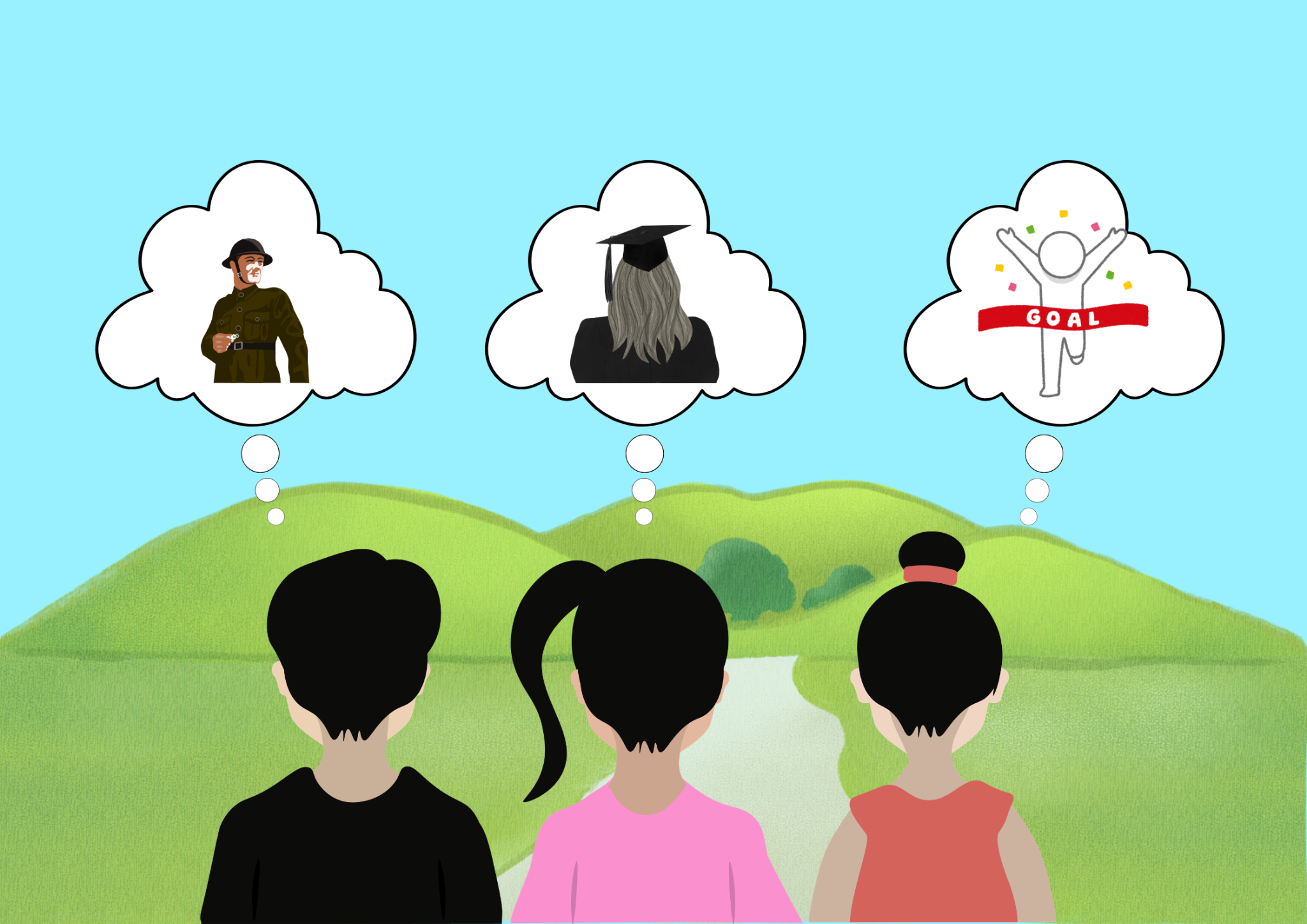
Regardless of if they are sitting in a classroom in Paluwa or walking through the trails of Helaucha, both boys and girls share a similar capability to aspire in the hills of Bhojpur. In our series of Focus Group Discussions, many boys shared that they were aiming for roles like pilots, doctors, or joining the army, while girls emphasized that everyone should set dreams and work diligently toward them. They see a future for themselves and believe they have the right to choose it. In the language of the capability approach, this is Agency Freedom, which is the ability to conceive, value, and choose a specific goal. However, a closer look at the local context reveals that dreaming is the easy part for them. The difficulty lies in Agency Achievement, or the actual power and resources needed to turn those goals into a lived reality.
Per Nussbaum’s Central Human Capabilities list (2011), the ability to imagine these futures prevents the formation of “pessimistic adaptive preferences”, where children might otherwise lower their sights to match a limited reality. Data from the baseline survey in the region shows that girls are often highly disciplined and focused on the process of achievement. They consistently emphasize that one must study properly, follow the right path, focus on instructions and set goals to be successful, and they are diligent in taking concrete steps and aligning their actions with their aspirations. Yet, we found that this agency is frequently internalized where girls are encouraged to study hard, but that their future is often framed around broad concepts like “success” or a “better future” rather than a diverse range of professional titles. This suggests a “concealed” aspiration set, where certain goals are held privately and never shared with the community (Hart, 2016). Girls work towards their goals in private, perhaps fearing that speaking too loudly might invite pushback. Their agency is active and structured, but it often operates quietly where the primary instruction is to stay focused and avoid negative environments, showing a drop in their ability to sustain outward communication with parents and teachers.
Boys experience a different reality, where aspirations are often more external and specific. Their agency is characterized by a high frequency of mentions for visible, authoritative roles such as the army (lahure), police, pilots, and engineers. They are comfortable communicating these plans, and their participation in the community is socially supported. However, while boys have a clear “voice” regarding their career paths, they sometimes lack the same emphasis on the sustained, disciplined goal-setting and step-taking that girls describe. For boys, the risk is that the aspiration remains a title to be claimed rather than a path to be meticulously built.
The biggest challenge for both genders is the consistent gap between imagining a future and practicing the steps to reach it. Previous research has found that young people are more likely to achieve positive outcomes when they develop ambition and achievable aspirations combined with self esteem and self efficacy (Social Exclusion Taskforce, 2008). In Bhojpur, a child’s desire to be a doctor or a scientist is met with a reality where teachers and parents provide inspiration, yet the enabling conditions for such transitions are often missing. In our discussions, we noted that for some children, the only visible path they saw towards fulfilling their aspirations is by traveling abroad to countries like Korea. In these scenarios, since the local infrastructure cannot support their dreams, their agency must be ‘exported’ to be realized. This creates a state of fragmented agency where girls have the discipline but often lack a public professional identity, while boys have the identity but may lack the disciplined path. In both cases, the lack of local enabling conditions forces a choice between abandoning the dream or pursuing it far from home.
Therefore, we must recognize that aspirations are multidimensional and not merely limited to career outcomes, and that they include the desire for inner peace or social belonging (Hart, 2016). When a society sets high aspirational goals through its education or legal systems, it creates a morally beautiful reality that can energize hope even when the current conduct of the world feels inadequate (Nussbaum, 2016). What we can observe in our research is that aspirations are not in short supply in Bhojpur. The children are already dreaming of becoming teachers, doctors, and pilots. The work that remains is building the social and material bridges that allow those dreams to travel out of the mind and into the world. We must move beyond simply telling children they should have goals and start addressing the structural and environmental barriers that stop them from reaching them. Success should thus be measured by how these aspirations are allowed to be carried out through their lives, and turning the freedom to choose into the permanent power to achieve something worthwhile.
References:
- Hart, C.S. (2016). How do aspirations matter? Journal of Human Development and Capabilities, 17 (3), 324-341.
- Nussbaum, M. C. (2011). Creating Capabilities. The Human Development Approach. Harvard: Belknap, Harvard University Press.
- Nussbaum, M.C (2016). Introduction: Aspiration and the capabilities list. Journal of Human Development and Capabilities, 17(3), 301-308
- Social Exclusion Task Force. (2008). Aspiration and attainment amongst young people in deprived communities: Evidence pack. Cabinet Office (United Kingdom).