Authors: Yamuna Basnet, Binayak Krishna Thapa
Children are often viewed through a lens of dependency and seen primarily as vulnerable subjects in need of protection and instruction. While all this is true, if we, as adults, continued acting with this limited worldview, we would be considering just the half needful towards understanding their well-being and doings. In this blog, we shed light on the other half, that being: children are social actors, and they have good judgement regarding their preferences, desires, and wants too. As children’s researchers, we have a firm conviction that children engage in negotiation with adult social actors for the things that they value and have reason to value, such as play, leisure, recreational activities, and time spent with friends and families.
Literature on children and childhood studies has shown that they are active agents and potentially shape the environment around them, whether it be at home, school, or the community they belong to. Therefore, it is important to consider this aspect of childhood while we research their doings and beings to assess their well-being. One of the important dimensions that sheds light on children’s well-being is the opportunity to exercise autonomy and the available processes children engage in for the realization of self-autonomy with respect to the time they have and personal decision-making on what they prefer, desire, and want. While researchers often limit assessing well-being to the possession and accessibility of resources and material goods, the consideration of autonomy for well-being evaluation relates to the importance of immaterial dimensions of children’s being and doing. However, our effort to understand children’s well-being comes along with challenges of conceptualizing, interpreting, and making sense of the complexities of ‘childhood’ in children’s daily life settings, whether in educational, residential, or community settings. Though adults have much influence on their beings and doings, we firmly believe that children have their own understanding of who they are and what their environment is like, and possess potential decision-making capacity on what they ought to do and be. In this regard, we see children as social actors possessing agency, and hence social agents in a given society. As social agents, children’s decisions shape their own lives, the lives of those around them, and their shared environments. They reason to shape their desires, preferences, and choices.
Hence, we believe children have agency, they exercise it, and this should be taken into consideration towards understanding and measuring their well-being. This agency aspect of children rightly informs autonomy as an opportunity that children can enjoy. Simply put, do children get time for leisure when they desire? Can they make their own decisions and be able to play and engage in recreation if they choose to? Do they have the opportunity to read and write when they have reason to value it? The answers to these fundamental questions can help gauge children’s agency to examine the freedom they have or the achievements they possess to realize their autonomy. Below, we delve into the concept of ‘autonomy’ and unpack its realization and actualization by the children based on what we experienced, and explore children’s daily lived experiences in the rural communities of the hills of eastern Nepal.
What does autonomy actually look like in a child’s daily life? While the concept of autonomy often exists as a legal or philosophical abstraction, its true value lies in the lived experience of a child navigating a Tuesday afternoon. In the hills of Bhojpur, this question is not answered in a textbook or a courtroom, but rather, on the steep trails between a community school and a family kitchen. It is something that is negotiated between the heavy expectations of the households, the rigid structures of the classrooms, and those quiet moments of choice when children walk back home through the tricky ridges. To answer this question through the Capability Approach, we must first distinguish between a child’s formal rights and their actual capabilities, which are the real opportunities that they have to be and do what they value. In the specific context of Bhojpur, this autonomy is not just a psychological state, but rather, a negotiation with the geography, labour and the evolving social structures.
When we observe the lives of the children in these hills, the first layer of autonomy seems straightforward. Most children report high levels of freedom, and they move across the terrain with an independence that would maybe be unfathomable to urban parents. They choose how to navigate through the slopes, how to spend their time playing in the communal spaces, and which activities they enjoy. On paper, their autonomy looks present, but when we move from what children feel they can do to what they actually do, and then further to what they actively choose and shape, the story becomes more complex, especially when we take into consideration that Sen and Nussbaum view these moments only as a rehearsal for the future (Liebel, 2014, pp.77-78).
Children in Bhojpur consistently report that they have the freedom to enjoy their leisure time by playing, reading or simply existing without pressure. Leisure appears to be the most protected space of autonomy, with it remaining not only strong in perception but also in practice. It is a space where adult control loosens, and children experience a degree of self-direction. Yet scholars like Saito (2003) suggest that these liberties only become relevant with regard to the future. This brings up the question: is the child’s play on a Bhojpur hillside a valuable end in itself, or is it merely something within the “protected bound” (Nussbaum and Dixon, 2012) to develop their future capacity for agency?
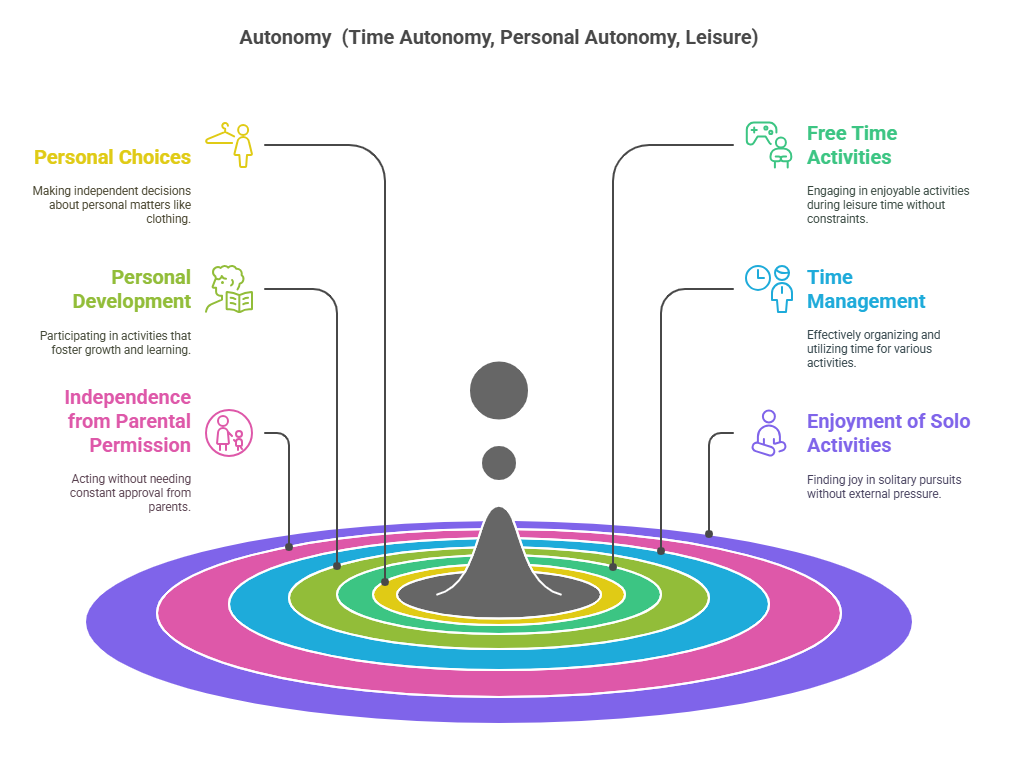
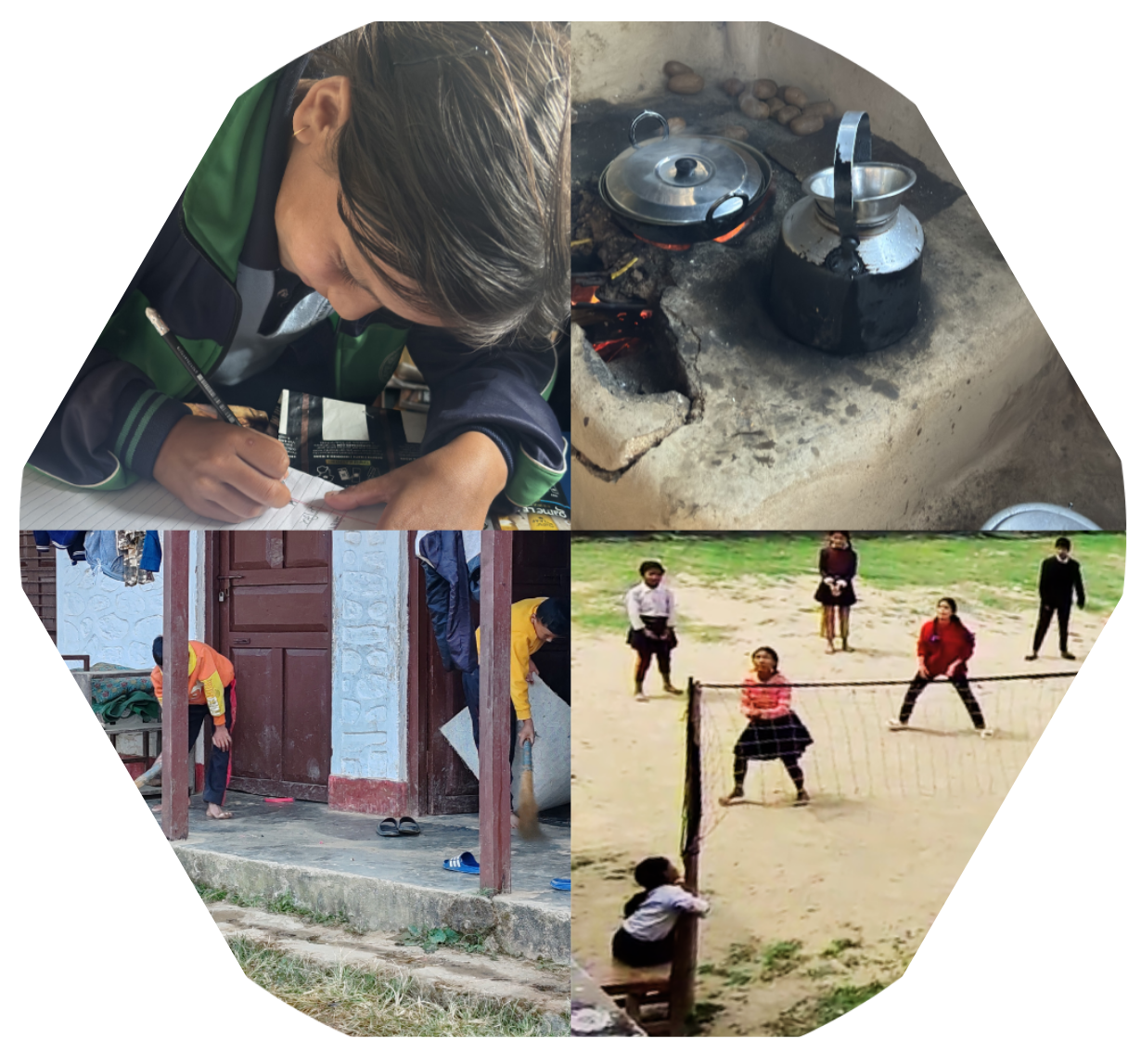
Our group discussions with children in Bhojpur revealed that their understanding of ‘time autonomy’ is often deeply tethered to responsibility rather than that of pure independence. When asked about managing their hours, the most frequent response from both boys and girls was not about freedom, but about “properly utilizing time”. For these children, owning time means following a routine, arriving at school on time to avoid punishment, and completing tasks to avoid regret. One child noted that without parental permission for their activities, they would “lack peace in their hearts”. For these children, autonomy is found not in rebelling against their routines, but in finding a sense of self within it.
This suggests that in the hills, autonomy is not the absence of authority, but a harmonious alignment with it, and one of the most revealing aspects lies in the idea of permission. Children often report they can do things without always asking their parents, yet when asked whether they see it as their own decision, the certainty weakens. This points to a form of autonomy that is negotiated rather than independent. In Bhojpur, the boundaries are not always explicit, but they are understood. Children navigate them carefully, knowing that their ‘decisional rights’ are often granted by adults as an opportunity to practice thinking rather than a true recognition of their current status as social subjects. The baseline results also showed that autonomy begins to thin out when we look at time itself. Many children say they are able to use their time well, yet fewer say they actually do so. The gap is subtle, but consistent, and it suggests that having time is not the same as owning it. In rural life, time is often structured by the unspoken rules of the harvest, the water tap, and the domestic routine. Even when a child is not being told what to do, the expectations of the family unit limit how freely that time can be shaped. This aligns with Nussbaum’s view that certain restrictions, like obligatory school attendance, are necessary to bring out future capabilities, even if they limit the child’s present self-determination.
Gender also adds another layer to this picture. Boys, on average, report slightly higher freedom across most areas with more instances of read and play time, and their definitions of time autonomy often include more active, outdoor pursuits like football or “moving as time passes”.
They feel more able to choose how they spend their time and move through the landscapes of Bhojpur without seeking permission. The difference is steady, reflecting a wider social pattern where boys are granted more visible space to act. Yet this does not mean boys experience stronger autonomy in all forms. They often show a larger gap between what they feel they can do and what they actually do in structured areas like personal development. They have the space, but they do not always own the choice within it.
Girls present a different, and more disciplined pattern. For a girl in Bhojpur, time autonomy is often a ‘double burden’, the ability to play only if household chores are simultaneously managed. In our sessions, girls mentioned the ‘importance of time’ five times more than the boys. This suggests that while boys have more space to act, girls possess a more disciplined ownership of the limited time they are granted. Their reported freedom is also slightly lower, especially in leisure and permission related indicators. They are the ones more often tethered to the domestic duties, but when they do report having that freedom, they are often more likely to act on it.
What emerges from these findings is not a simple story of children having or lacking autonomy, but rather, a story of uneven autonomy. Children are most free where expectations are lowest, in play and moments, and as we move toward areas that shape the future, autonomy becomes more constrained and less fully realized. We must move beyond the views of Sen and Nussbaum, who often see these moments merely as a ‘rehearsal’ for future agency. Instead, we should recognize the current struggle of these children to turn options into meaningful actions. Therefore, autonomy is not only about being allowed to move, it is about whether a child can turn those options into choices they recognize as their own, and in a space that truly belongs to them.
Note: This blog is an output of the project titled ‘Promoting Gender Equality and Social Inclusion in Schools: Building on What Children Value and Aspire to Do and Be,’ implemented by LIKE Lab, Kathmandu University School of Arts, with support from the Global Partnership for Education and Innovation Exchange (GPE KIX) and the International Development Research Centre (IDRC).
Disclaimer: The views and opinions expressed herein do not necessarily represent those of the International Development Research Centre (IDRC) or its Board of Governors.
References:
- Liebel, M. (2014). From Evolving Capacities to Evolving Capabilities: Contextualizing Children’s Rights. In: Stoecklin, D., Bonvin, JM. (eds) Children’s rights and the capability approach (pp.77-78). Springer Dordrecht. https://doi.org/10.1007/978-94-017-9091-8.
- Dixon, R., Nussbaum, M. C. (2012). Children’s rights and a capabilities approach: The question of special priority. The Law School. The University of Chicago. Public Law and Legal Theory Working Paper No. 384, vol. 97
- Saito, M. (2003). Amartya Sen’s capability approach to education: A critical exploration. Journal of Philosophy of Education, 37(1), 17–33.