Authors: Yamuna Basnet, Binayak Krishna Thapa
For the last two years, researchers at the Learning Innovation and Knowledge Exchange Lab (LIKE) have been working to understand children’s perspectives on their own well-being and “becoming.” This blog stems from a formative study and subsequent baseline conducted in Bhojpur Municipality, Nepal, covering 13 community schools selected for their caste, gender, and ethnic inclusivity.
The research engaged 234 students (117 girls and 117 boys) in 26 focus group discussions (FGDs), and during these workshops, children evaluated 21 commonly used well-being indicators on a scale of 1–10. “Mental Well-being” was the lowest-ranked and least understood domain of all 21 indicators. This poor scoring revealed a significant gap: psychological and emotional health remains a poorly recognized aspect of well-being in children’s perceptions. In our initial indexing (scaled to 6.25) of the baseline scores, we saw that:
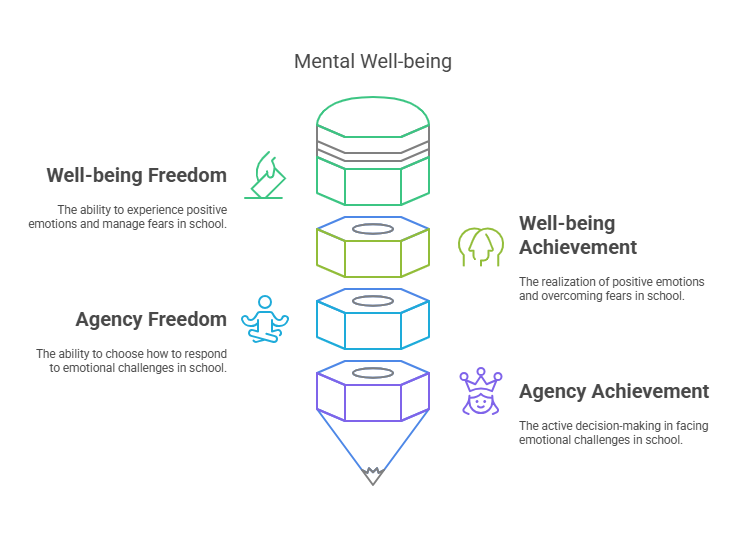
- Well-being Freedom: Scored only 5.32 out of a maximum 6.25.
- Well-being Achievement: Even lower at 5.12.
- Agency Freedom/Achievement: Lagged at 5.29.
This data suggests that children not only struggle to define mental health but also lack the perceived freedom and agency to navigate it. When we asked a group of children from grade 1 – 10 to define mental well-being, we were expecting descriptions related to feelings, relationships, security or even inner states. However, surprisingly, many responses moved towards advice like exercise, meditation, not stressing about things, thinking positively, sharing problems and staying calm. Across all the grades, most statements did not define mental well-being itself, rather, they described ways to achieve it.
Among the boys, only 2 instances were captured which directly defined mental well-being. 7 statements focused on solutions or behaviours associated with being mentally healthy. Girls showed a similar pattern where their responses emphasized actions such as sharing problems with family or teachers, engaging in sports, avoiding tension, maintaining peace of mind and practising meditation. While one of their statements referenced consequences such as depression or conflict, neither they nor the boys could clearly articulate the causes. What we garnered from this discussion is that children understand mental well-being as something one must “do” to maintain rather than something one is “entitled” to experience.
Amartya Sen’s Capability Approach, further expounded by those like Nussbaum, distinguishes between ‘capabilities’ and ‘functionings’. Within this framework, mental well-being is not merely the practice of yoga, exercise or positive thinking, instead it refers to the genuine opportunities experienced by the children to enjoy emotional and psychological safety, dignity, and emotional stability. When the children described coping strategies in the discussions, it suggested that they see mental well-being as something of an individual responsibility rather than a socially supported condition. Many of their responses framed mental well-being as that of self-regulation with examples like 1) Do not worry 2) Avoid negative thoughts 3) Stay calm 4) Engage in hobbies 5) Share problems and 6) Practice meditation. While these statements appear meaningful, they also hinted towards their internalized expectations that individuals must manage distress largely on their own. As researchers in the field of capability approach, this raises the question: Do children perceive their emotional security as something guaranteed within their environment? Or do they see mental well-being as something fragile that must be continuously maintained through effort?
While children may know the techniques for calming themselves, the environment around them may not necessarily be supportive of their emotional security. Girls articulated more references to social relationships such as sharing problems with friends, parents and teachers. They also mentioned community conflict as a source of distress and were more sensitive to instances of discord. However, similar to the boys, their descriptions still strongly leaned towards behavioral descriptions rather than that of internal states. Based on these data sets, the possible interpretations that emerge are:
- Children may repeat language commonly used by adults or schools such as ‘positive thinking’, ‘stress management’ and ‘meditation’.
- Mental well-being may be framed as a matter of personal discipline rather than that of collective care.
- The younger grade participants may have limited vocabulary to describe complex psychological states.
If mental well-being is primarily understood as a behaviour, interventions may focus narrowly on training children to regulate themselves rather than looking at the environment around them that shapes their daily experiences. And as capability informed researchers, we should examine whether children have genuine opportunities to experience the following, as without these, coping strategies may very well function as compensatory tools rather than expressions of flourishing in these children’s inner worlds:
- emotional safety in classrooms
- respectful teacher student interaction
- peer environments free from humiliation
- trusted adults who listen without judgment
- time for rest, play and creative expression
- freedom from excessive performance pressure
To investigate whether these internalized expectations were a result of genuine agency or a response to structural gaps, we followed the focus groups with a baseline survey, which allowed us to measure the “capability” of the children more precisely. Using a GESI Diagnosis Framework, we asked students to rank four key areas: well-being freedom, well-being achievement, agency freedom, and agency achievement.
When we asked children about their mental well-being in school, most answers appeared to be positive, and upon looking at individual perceptions on a standard 1-10 scale, the scores stayed above eight across all questions. Many children responded that they feel happy coming to school, that they do not feel scared, and that they are able to stay positive when faced with difficulties. While this sounds reassuring, the capability approach encourages us to look at their answers more carefully. It encourages us to question if the children not only feel okay, but also feel that they have the real freedom to feel okay, and if they have the agency to respond when they do not feel okay. A child might report feeling happy at school, but do they feel free to be unhappy when something goes wrong? A child might say they are able to stay positive, but do they feel they have the choice to seek help when they struggle? Across the data collected, well-being freedom and well-being achievement scores remained very close to each other. This suggests that many children who feel able to experience positive emotions also report actually experiencing them. In capability terms, the conversion from freedom into achievement appears relatively smooth; children not only see emotional well-being as being possible, they also often experience it in practice.
Their agency freedom and agency achievement scores also remained high with many children reporting that they have a choice in how they respond to emotional situations. They feel that they can 1) seek help when they feel scared 2) that they can decide whether to share their feelings and 3) that they can choose to remain positive when difficulties arise. This suggests that children not only experience emotional states passively, but that they also see themselves having a role in shaping those states. However, across four capability spaces one pattern stood out quietly. Children report slightly lower scores when it comes to sharing their feelings compared to feeling happy or staying positive. They appeared more comfortable saying they feel good than saying they talk about feeling bad. They seem more confident in managing their emotions internally than expressing them externally. Emotional well-being is not only about internal strength, but also about having the freedom to express discomfort without fear. When children feel that they are able to cope, but slightly less able to share, it can mean that their emotional struggles remain less visible. A child who stays positive despite facing difficulties may still be facing that difficulty alone.
The data also shows that fear related indicators score relatively well. Many children reported not feeling scared in school, and that they have the choice to seek help when they do need help. Another interesting point relates to staying positive during difficulty, with the scores for positivity remaining high across all capability spaces, with children seeming to believe that they are able to maintain a positive outlook even when facing challenges in school. While this may reflect resilience, it may also reflect expectations children feel about how they should respond. This is why the distinction between freedom and achievement is so important. High achievement scores do not always mean there are no constraints, it may also mean that children have learned to live with those constraints. While the qualitative discussions (FGDs) suggested children felt a heavy burden of self-regulation, the survey data provided a more complex picture. When we looked at the importance, availability and satisfaction levels relating to school resources, there was a clear “unmet need.” For instance, a grievance mechanism, a vital structural indicator for mental well-being, received a high importance score (1562 out of 1900 points) but significantly lower ratings for availability (1199) and satisfaction (1214). This divergence confirms our earlier suspicion that while children are taught to “stay positive,” the institutional structures required to support that positivity are often lagging behind.
Overall, the findings suggest that children experience schools as being emotionally safe, and that they feel happy to attend it. They do not feel overwhelmed by fear and believe they can remain positive when difficulties arise. At the same time, the slightly lower scores related to sharing feelings remind us that emotional expression may still be shaped by social expectations. Children may feel pressured to appear strong, calm or well-adjusted and that their struggles should be managed quietly. The capability approach encourages us to see mental well-being not only as a personal quality but as a condition shaped by relationships and environments. A supportive school is not only one where children feel happy, but also one where children feel free to admit when they are not. The difference between feeling okay and being free to not feel okay may appear small in numbers, yet it carries important meaning. True mental well-being includes the freedom to experience a full range of emotions, the agency to respond to those emotions, and the confidence that expressing difficulty will be met with understanding rather than judgment. Thus, improving mental well-being may not require large structural interventions if baseline emotional security is already high. Because the data reveals a gap between internal resilience and external expression, improving well-being in this context does not require large structural overhauls, but rather targeted ‘marginal gains’ such as:
- Addressing the “unmet need” for grievance mechanisms by creating anonymous, trusted feedback loops.
- Moving the school narrative away from “staying calm” and toward the “freedom to express discomfort” without judgment.
- Training teachers to respond to vulnerability with constructive support rather than just encouraging “positive thinking.”
- Ensuring that “seeking help” is viewed as an exercise of agency rather than a failure of self-discipline.