Parameeta Maharjan
As a bachelor’s student in Community Development at Kathmandu University School of Arts (KUSOA), I am currently completing my internship at the Learning, Innovation, and Knowledge Exchange (LIKE) Lab, as part of the requirements for my undergraduate degree. Before joining the Lab, I viewed development primarily as the process of identifying community problems and designing interventions to address them. However, my internship at LIKE Lab broadened my understanding of what development truly entails. I came to realize that designing an effective intervention is only the beginning. The greater challenge lies in ensuring that successful initiatives can be sustained, adapted across diverse contexts, and scaled to create meaningful and lasting impact for a larger population.
Learning Through Research and Scaling Science
LIKE Lab is a social science research lab at Kathmandu University School of Arts (KUSOA), Hattiban, Lalitpur, established in 2021. Its inception was made possible through a grant awarded by the Global Partnership for Education Knowledge and Innovation Exchange (KIX) and the International Development Research Centre (IDRC). The lab focuses on generating evidence-based, scalable, and sustainable solutions to complex socio-economic and socio-political challenges. Its work includes applied research, community-based interventions, policy engagement, capacity building, monitoring and evaluation, and knowledge exchange. LIKE Lab collaborates with communities, local governments, schools, teachers, children, and development partners to co-design, test, and evaluate innovative solutions that address local needs. Beyond conducting research, the lab emphasizes translating evidence into practice by strengthening local systems and exploring how successful interventions can be sustained and scaled to create broader social impact.
As part of my internship, I had the opportunity to explore various theses, field reports, and research conducted by senior researchers, including Situ Shrestha, Shreeshna Bajracharya, Gatha Shree Dahal, and Utkrishta Sharma. These reports introduced me to important themes in community development such as disability inclusion, children’s well-being, resource accessibility, child rights, Gender Equality and Social Inclusion (GESI), and meaningful participation. Reading these studies not only strengthened my understanding of research methodologies but also demonstrated how evidence generated from communities can guide interventions that respond to local realities.
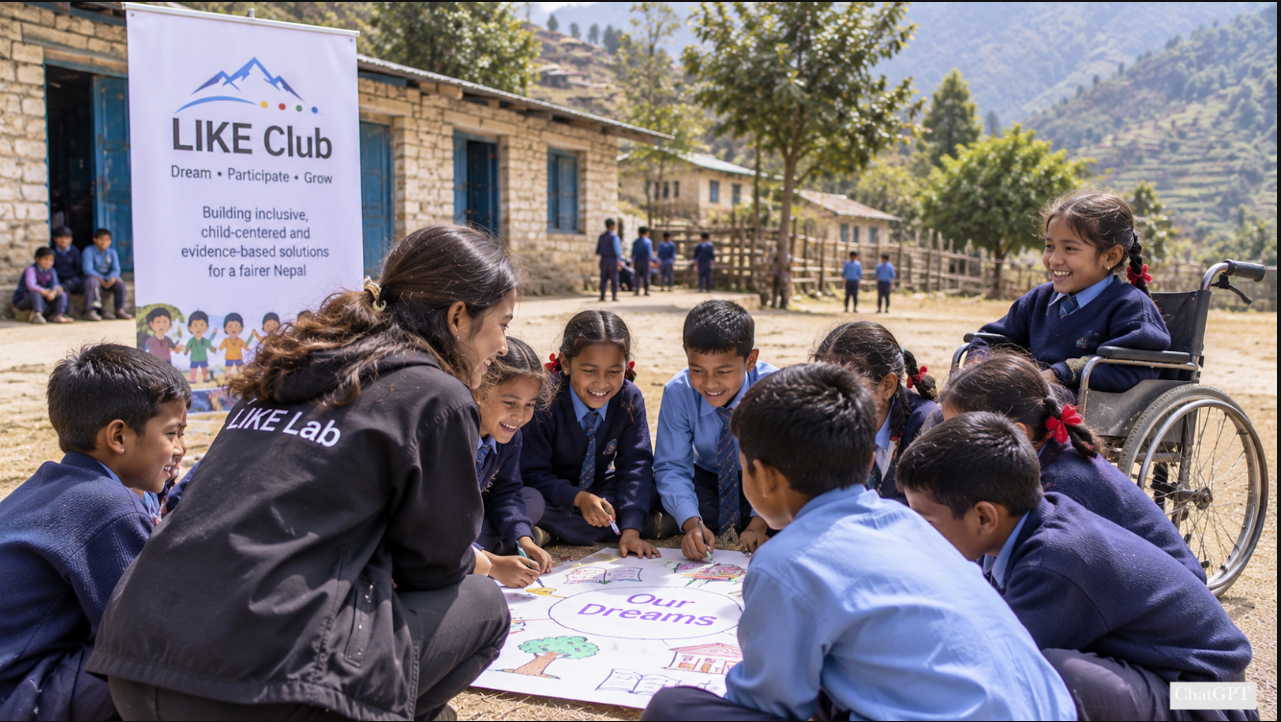
Under the current three year project “Promoting Gender Equality and Social Inclusion in Schools Building on What Children Value and Aspire to Do and Be”, running from 1 March 2024 to 28 February 2027, one of LIKE Lab’s major initiatives is the establishment of child-led clubs called ‘LIKE Clubs’. The project is being implemented in 13 community schools in Bhojpur Municipality, Koshi Province, Nepal, as part of a broader initiative to promote gender equality, social inclusion, and children’s well-being through education.
Unlike conventional child clubs, the LIKE Club is designed as a child-led platform where students actively participate in discussions, leadership activities, decision-making, and initiatives that promote inclusion, participation, and well-being within their schools and communities. The project adopts a collaborative approach by working closely with teachers, school management committees, local governments, and Gender Equality and Social Inclusion (GESI) focal persons to strengthen institutional support and ensure that these practices become embedded and sustainable within the school system. Through this initiative, children are recognized not merely as beneficiaries but as active agents of change whose voices, values, and aspirations contribute to creating more inclusive and equitable learning environments.
Alongside this, our seniors at LIKE Lab introduced us to the previous reports and theses completed by former interns and researchers, and guided us through the Scaling Science online course, which provided a strong foundation for understanding the principles and practices of scaling social innovations. Initially, I questioned why this module was included as part of our internship. However, as I progressed through the course while simultaneously reading the LIKE Lab reports, I realized how closely the two complemented each other. The reports showed how interventions were designed and implemented, while the Scaling Science modules challenged me to think about how to scale and what the interventions required for successful scaling. How can a successful intervention move beyond one community? What conditions are necessary for it to succeed elsewhere? How can we preserve its quality while expanding its reach?
Before taking the course, I assumed scaling science was a concept mainly associated with laboratories and scientific discoveries. Through the modules and the work carried out by LIKE Lab, I learned that scaling science is equally important in the field of community development. It is not simply about expanding a project to more locations; rather, it involves understanding the systems, institutions, partnerships, and local contexts that enable an intervention to grow sustainably while maintaining its effectiveness.
One report that particularly strengthened my understanding was “LIKE CLUB” Initiative in Rural Community Schools of Bhojpur Municipality and Local Institutional Setups: Opportunities and Challenges, by Utkrishta Sharma (2025). The report analysed the readiness of schools and local institutions to support the expansion of the LIKE Club model, and rather than focusing solely on the success of the intervention, it examined the institutional, social, and organizational factors that influence whether the initiative could be sustained and scaled effectively.
Beyond Research: Learning Through Knowledge Exchange
Aside from generating knowledge through research, LIKE Lab undertakes a wide range of activities, one of which is organizing knowledge-sharing and knowledge-exchange events with researchers, academic institutions, and development organizations. Beyond the research reports, blogs, and news articles regularly published by the lab, these events serve as platforms to disseminate knowledge while also creating opportunities to exchange ideas and learn from experts working in the field of education and community development. During my internship, I had the opportunity to participate in several of these events and discussions.
These experiences allowed me to interact with researchers, faculty members and fellow team members while gaining insight into ongoing projects and the importance of evidence-based research in community development. Through presentations, discussions, and reflections on field experiences, I developed a deeper understanding of how research findings can inform policies, strengthen local institutions, and contribute to sustainable development. Furthermore, these events highlighted the collaborative nature of development work, demonstrating that meaningful and lasting change is achieved through partnerships among researchers, communities, local governments, and development practitioners who work together to co-create solutions rather than operating in isolation.
Key Reflections on Scaling for Sustainable Development
What stood out to me most was that successful scaling depends on much more than having a good idea. The report demonstrated that collaboration among the stakeholders: teachers, students, local governments, school leaders, and communities, is essential for sustaining change. At the same time, it identified practical challenges such as limited financial resources, inadequate infrastructure, insufficient institutional capacity, and the need for stronger coordination. These findings closely reflected the principles discussed throughout the Scaling Science course, particularly the importance of assessing readiness before attempting to expand an intervention.
Another valuable lesson I gained was the importance of local ownership. Sustainable development cannot be achieved if communities are treated merely as beneficiaries. Instead, communities need to become active partners in designing, implementing, and improving interventions. The LIKE Club demonstrates this by creating opportunities for children, teachers, parents, and local governments to collectively shape the initiative according to their own context. This showed me that scaling is not about replicating the exact same model everywhere; it is about adapting successful ideas while respecting local needs and realities.
As someone studying Community Development, this learning experience helped me appreciate that many innovative projects in Nepal never move beyond the pilot stage despite producing promising results. One of the major challenges is not the lack of innovative ideas but the difficulty of institutionalizing and sustaining them within existing systems. Research on Nepal’s development sector has consistently highlighted that weak institutional capacity, inadequate planning, limited accountability, and dependence on short-term external funding often prevent successful interventions from being scaled or sustained beyond their initial implementation phase (Bista, 2022; Ojha, 2021). This realization reinforced the importance of designing interventions with scalability and sustainability in mind from the very beginning rather than treating scaling as an afterthought. Scaling Science provides a framework for understanding how these initiatives can transition from isolated successes into sustainable systems that benefit many more communities. It encourages development practitioners to think beyond project completion and consider long-term institutionalization, partnerships, policy engagement, and continuous learning.
Conclusion
Overall, my internship at LIKE Lab, participation in various events and knowledge-sharing sessions, and engagement with the Scaling Science course have transformed the way I understand development. The work of LIKE Lab and the LIKE Club initiative has shown me that sustainable social transformation often begins with a local initiative, an idea or intervention developed to address the specific needs and aspirations of a particular community. One of the most valuable lessons I learned is that scaling is not simply about replicating the same intervention in different places. For instance, the LIKE Club model cannot simply be replicated in a new school or community as a one rigid template. A structure that functions effectively in Bhojpur Municipality may require significant adaptation in another district to accommodate differences in local school dynamics, community contexts, and institutional capacities. Every community has its own social, cultural, economic, and institutional context, which shapes how an intervention is received and whether it will succeed. A local initiative that works well in one setting may not produce the same results elsewhere unless it is carefully adapted to local needs, available resources, and community priorities. This helped me understand the successful scaling is not about copying a solution but about learning from what works, understanding the local context, and adapting the initiative while preserving its core principles. Ultimately, I now see development as a process of supporting local initiatives and enabling them to grow in ways that are context-sensitive, sustainable, and capable of creating meaningful, long-term impact.
Reference:
Bajracharya, S. (n.d.). Exploring the multidimensionality of scale: A study of the community action group for education initiative at Durga Bhagwati Rural Municipality.
Bista, I. (2022). Issues with development projects in Nepal: A case study of the development projects in Nepal and its issues using the agent-based approach (ABA). Journal of Systems Thinking.
Dahal, G. S. (n.d.). The multi-dimensionality of scaling extra curricular activities (ECA) program in public schools of Rautahat district.
Ojha, H. R. (2021). Quest for development: An examination of more than a half-century of national planning and foreign aid practice in Nepal. Sustainable Futures, 3, Article 100051.
Sharma, U. (2025). LIKE CLUB initiative in rural community schools of Bhojpur Municipality and local institutional setups: Opportunities and challenges. LIKE Lab.
Shrestha, S. (n.d.). Scalability: A diagnosis on the potentiality of a scaling program for strengthening public schools.