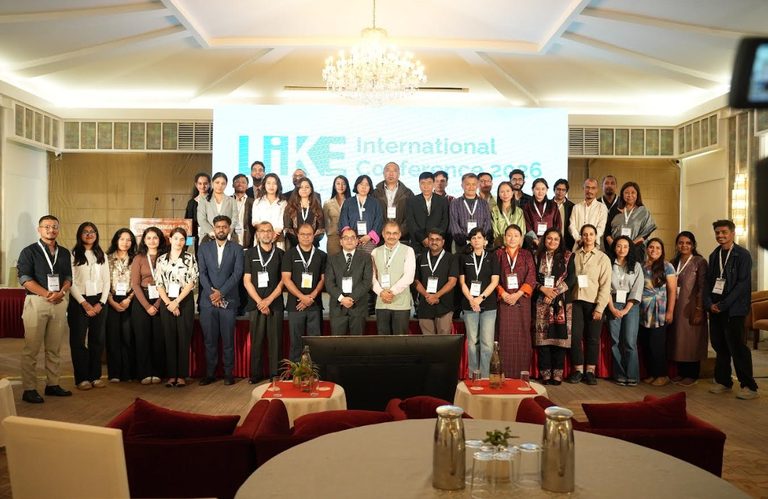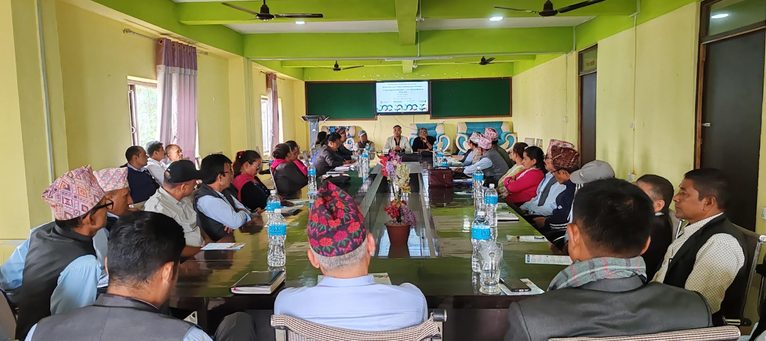
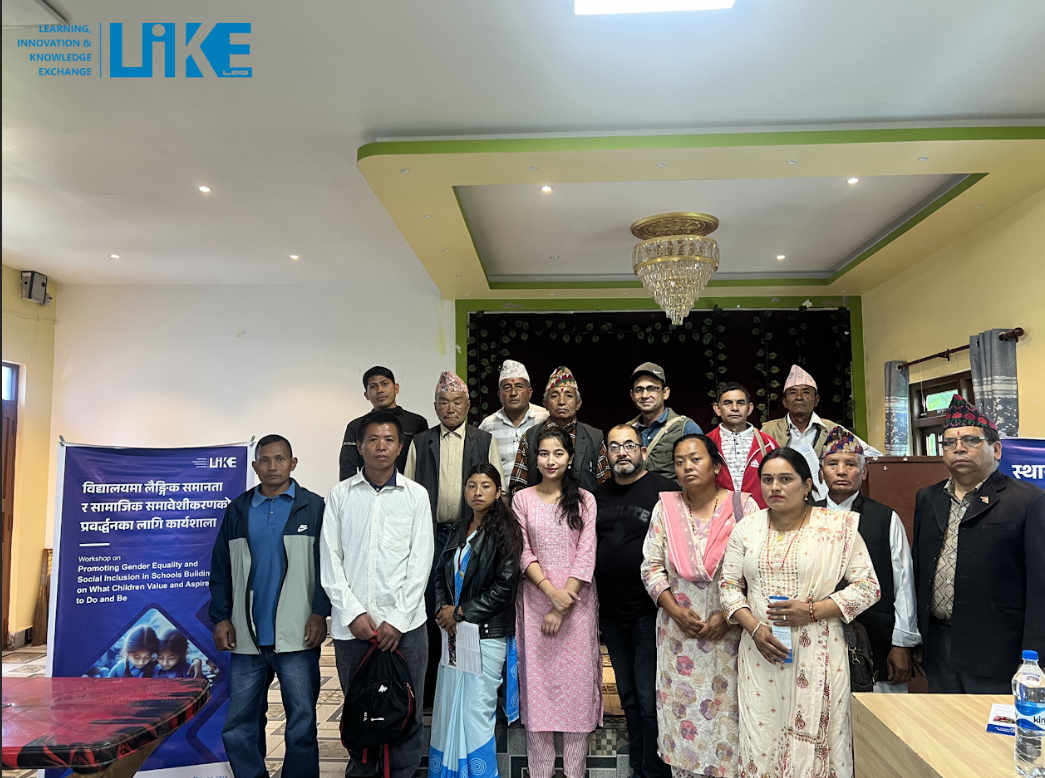
BHOJPUR, NEPAL, JUNE 24, 2026 – The Learning, Innovation and Knowledge Exchange (LIKE) Lab at Kathmandu University School of Arts organized a community-level event under the “Promoting Gender Equality and Social Inclusion in Schools: Building on What Children Value and Aspire to Do and Be (CVEC Project)”. Held at the Vintuna Hotel, the session included the attendance of School Management Committee (SMC) and Parent Teacher Association (PTA) members from the 13 partner schools.
The Knowledge Sharing Program aimed to share the findings of the 2025 Baseline Survey and present the newly created LIKE Club Activity Book video to the educational stakeholders. The event commenced with Mr. Saurav Rajbhandari warmly welcoming the event participants and giving a short introduction to the project. He also shared that LIKE Clubs have reached one year of establishment in the 13 community schools, and that the project aims to further sustainably expand this initiative to the remaining 30 community schools in the Bhojpur Municipality by the end of the project.
The program then moved forward with Ms. Yamuna Basnet giving a brief introductory overview of LIKE Lab and its core values and objectives. She went on to present the findings of the baseline survey conducted in February 2025, which aimed to understand the situations of community schools pre-intervention.
The key highlights from her presentation included:
- The survey methodology and a brief introduction to the Capability Approach as a guiding theoretical framework.
- The two distinct spaces of evaluation which included 1) the assessment of the availability, satisfaction and importance of the resources and 2) the status of children’s well-being and agency
- Findings that noted the infrastructural limitations which included the lack of sufficient sanitary pads and spaces for their disposal, and the school premises not being disability friendly despite stating otherwise.
- The gap between children’s well-being and agency and the factors behind it.
- The segregated results based on gender, ethnicity, and grade.
- Suggestions moving forward
Mr. Saurav Rajbhandari then presented the latest Activity Book, as well as the 16 Capability videos to the Headteachers to refamiliarize them with the concept and value of LIKE Clubs, and how the club activities can be seamlessly integrated into the existing school curriculum, ECA, and morning assemblies at no cost.
Group Discussion: Highlights
- Community schools are weak and marginalized and there is a great divide between community and private schools. They are losing students due to urbanization, migration for a better life, and agricultural labor engaging the youth. Students favor private education, leaving rural community schools with decreasing numbers and facing closure.
- Even government officials invest in private tutoring for their own children; community schools should therefore educate the children of civil servants to bring about structural change. Resources are unequally distributed, and community schools must be provided with facilities as good as private schools.
- While community school teachers have degrees, quality human resources are missing and educational outcomes are not up to standard.
- There needs to be strict accountability across all levels: teachers, parents, students, and the school management committee.
- The distributed club materials are good, but the program needs more student engagement, better coordination, and implementation through local institutions.
- The government must be informed about this program, and community awareness is needed so locals take ownership of these schools.
Closing Reflections
Dr. Binayak Krishna Thapa, the Principal Investigator of the CVEC Project, thanked the SMC and PTA members in attendance for their valuable suggestions, and stated that they play an important role in promoting accountability within their respective schools by acting as monitoring agents. LIKE Clubs are meant to be instruments of change to further enhance children’s capabilities, and ensuring that schools actively facilitate these activities paves the way for children to get a fair chance at having a meaningful educational experience despite the resource constraints. He then concluded the session by expressing hope for continued support and cooperation in the future.