Author: Utkrishta Sharma
Position: Junior Researcher, LIKE lab, Kathmandu University School of Arts (KUSoA)
Have you ever wondered why some educational interventions succeed in certain schools but struggle to achieve similar results elsewhere despite being carefully planned and funded? Implementing and scaling an educational intervention across different schools or communities is a complex, long-term, and iterative process rather than simply copy-and-pasting a successful model.
The Center for Universal Education (CUE) at the Brookings Institution defines “scaling” as ranging from deliberate replication to the deep integration of initiatives into national systems to create lasting improvements in people’s lives (Wyss et al., 2023). However, the reality is thought-provoking: studies show that fewer than 5% of interventions successfully progress beyond the pilot stage (Cooley & Howard, 2019). This massive gap between pilot success and large-scale impact highlights why assessing the readiness level of any intervention is a strategic necessity. For any intervention to become successful, those implementing it need to have the ability to look beyond the plan and understand the local context. Crucially, this means assessing whether stakeholders and beneficiaries are willing and capable of sustaining the work even after the external support ends. Readiness, therefore, is not a simple “yes or no” checklist. It reflects how prepared people and systems are and whether they possess the capacity and resources needed to make an initiative effective over the long term (Dymnicki et al., 2014; Wandersman Center, 2018; Walker et al., 2022).
Insights from the Field: The LIKE Club in Bhojpur Municipality, Nepal
This blog reflects on insights gained through fieldwork experience assessing the institutional readiness of 13 community schools in Bhojpur Municipality, Koshi Province, Nepal, proposed for establishing LIKE Club, a student-led child club aiming to promote the values of Gender Equality and Social Inclusion (GESI), leadership, teamwork, and respect through student-organized activities. It shares the learnings on why understanding readiness is a crucial first step in planning, implementing, and scaling interventions.
The fieldwork in Bhojpur was conducted to fulfill the requirements of an undergraduate degree in Community Development through a rural internship report titled “LIKE Club Initiative in Rural Community Schools of Bhojpur Municipality and Local Institutional Setups: Opportunities and Challenges.” The study was a part of the project “Promoting Gender Equality and Social Inclusion in Schools: Building on What Children Value and Aspire to Do and Be,” implemented by the Learning, Innovation, and Knowledge Exchange (LIKE) Lab at Kathmandu University School of Arts (KUSOA) with support from the Global Partnership for Education and Innovation Exchange (GPE KIX) and the International Development Research Centre (IDRC).
This study examined the institutional readiness of 13 community schools in Bhojpur Municipality to establish, operate, and scale the LIKE Club within their respective school environments. The study was guided by two research questions: (1) What roles do headteachers, GESI focal persons, and students play in establishing, operating, and scaling the LIKE Club to promote GESI? and (2) What opportunities and challenges influence the establishment, operation, and scaling of the LIKE Club in selected community schools of Bhojpur Municipality?. The GESI focal persons were the social studies teachers in each of the schools who played the role of guiding the students, linked the club with the school administration, and ensured the club activities followed the school’s policies.
To address these questions, the study adopted a mixed-methods approach. Quantitative data were collected using an institutionalization tracker administered to 26 respondents, who were the head teachers and GESI focal persons from 13 selected community schools. The tracker was tailored to fit the context of the selected schools. The tracker assessed institutional readiness across multiple domains, including existence, readiness, governance, human resources, curriculum and materials, information, stakeholder engagement, and equality and inclusion. Complementing this, qualitative data were gathered through structured interviews with 32 students from five community schools to understand their awareness, willingness, and perceptions of child clubs, leadership roles, and GESI concepts.
Assessing Readiness: Learnings from the School Visits.
During field visits to thirteen community schools, the findings showed that most schools demonstrate a moderate to high level of readiness to establish and scale the LIKE Club. The readiness was reflected in strong leadership commitment, supportive school environments, and high levels of student enthusiasm. Headteachers and the GESI focal persons generally showed positive attitudes toward promoting inclusion, equity, and student leadership. Students also expressed strong interest in participating in club activities and training, viewing the LIKE Club as an opportunity to develop leadership, cooperation, and confidence.
The level of institutional readiness was measured using a scale of 1-4, where 1 represented “low institutionalization,” 2 represented “emerging institutionalization,” 3 represented “significant institutionalization,” and 4 represented “full institutionalization.” Scores across each of the mentioned domains were used to evaluate each school’s readiness levels to establish, operate, and scale the club. This assessment helped to reveal the varying levels of readiness, with some schools demonstrating higher levels of readiness than the others. The table below presents the overall readiness scores, which formed the basis of comparison of readiness level among the 13 community schools.
| S.N | School’s Name | School Level | Readiness Level on a Scale of 1–4 |
| 1. | Shree Singhadevi Madhyamik Vidhyalaya (Ma. Vi) | Secondary Level | 3.14 |
| 2. | Shree Kalika Madhyamik Vidhyalaya (Ma.Vi) | Secondary Level | 3.23 |
| 3 | Shree Panchakanya Aadharbhut Vidhyalaya (Aa.Vi) | Basic Level | 3.08 |
| 4 | Shree Siddheshwar Madhyamik Vidhyalaya (Ma.Vi) | Secondary Level | 2.91 (Lowest) ⬇️ |
| 5 | Shree Panchakanya Madhyamik Vidhyalaya (Ma.Vi) | Secondary Level | 3.33 |
| 6 | Shree Panchakanya Prathamik Vidhyalaya (Pra.Vi) | Primary Level | 3.12 |
| 7 | Shree Jansewa Aadharbhut Vidhyalaya (Aa.Vi) | Basic Level | 3.48 (Highest) ✅ |
| 8 | Shree Sarswati Aadharbhut Vidhyalaya (Aa.Vi) | Basic Level | 2.99 |
| 9 | Shree Jankalyan Aadharbhut Vidhyalaya (Aa.Vi) | Basic Level | 3.19 |
| 10 | Shree Jalpa Madhyamik Vidhyalaya (Ma. Vi) | Secondary Level | 2.92 |
| 11 | Shree Jankalyan Madhyamik Vidhyalaya (Ma.Vi) | Secondary Level | 3.17 |
| 12 | Shree Yasodhara Madhyamik Vidhyalaya (Ma.Vi) | Secondary Level | 3.33 |
| 13 | Shree Biddodaya Madhyamik Vidhyalaya (Ma. Vi) | Secondary Level | 3.44 |
Furthermore, interactions and observations also revealed that readiness extends far beyond physical infrastructure. Readiness was reflected through the willingness of teachers to provide leadership and the positive attitudes of stakeholders toward the intervention. These insights revealed how institutional capacity, stakeholder understanding, and a commitment to equality and inclusion shape specific opportunities and challenges. Ultimately, these factors determine the school’s collective ability to execute and sustain the initiative effectively, moving beyond participation to long-term impact.
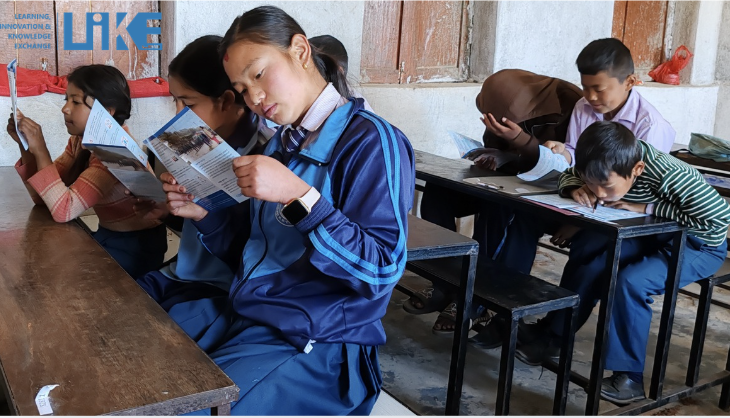
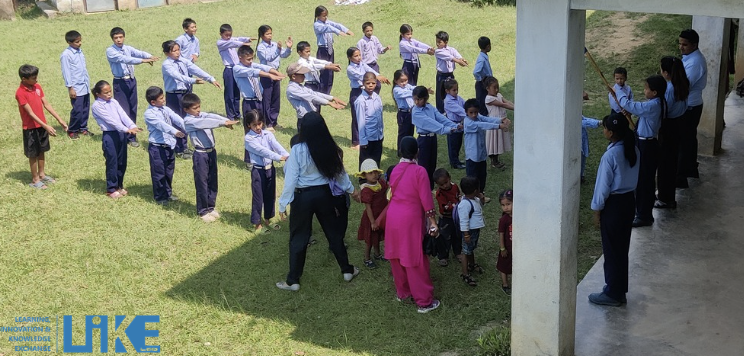
In some schools, the headteachers spoke about their hopes for students’ growth and the importance of giving them spaces for learning beyond textbooks. Teachers shared that they already encouraged students to participate in activities in their school and expressed strong interest in supporting the LIKE Club. Readiness also became evident in interactions with students. Many expressed excitement about the LIKE Club, sharing that it could help them build confidence, develop leadership skills, organize activities, play sports like volleyball and football, learn values of GESI, respect, and teamwork, and provide a safe space where their voices could be heard.
In other schools where readiness level was comparatively lower, students had a limited understanding of what a child club is, how it is formed, and how it is led. Having never participated in a formal club, many were unaware of the benefits of membership or how to serve on the Board of Directors (BoD) in roles such as president, vice president, treasurer, or secretary. Teachers also raised concerns about tight academic schedules and insufficient material and financial resources to support the club effectively. These limitations pointed to gaps in readiness that would likely affect early implementation without additional support.
Overall, the study concluded that establishing and scaling the LIKE Club is both feasible and necessary within the selected community schools. A phased, context-sensitive approach that begins with high-readiness schools serving as model sites and that uses their experience to train and support lower-readiness schools through targeted training, interactive workshops, and resource support can assist to enable sustainable implementation of the LIKE Club.
Why Readiness Assessment Matters for Scaling and Sustainability
The differences observed across schools in Bhojpur highlight the importance of conducting a readiness assessment before initiating an intervention. Understanding a school’s level of readiness enables implementers to predict potential challenges, identify needed resources, and tailor interventions to the local context. Without this step, scaling initiatives may result in ineffective execution, limited ownership, and reduced effectiveness.
Implementers can make well-informed decisions during implementation and scaling by incorporating readiness findings into intervention planning. Evaluating readiness helps determine the resources and assistance required, anticipate potential opportunities and challenges, and assess the early willingness of the community and stakeholders to accept the intervention. Readiness assessment ensures that educational initiatives such as the LIKE Club are well-informed and guided by evidence and tailored to fit the unique context of each environment rather than being a simple replication or one-size-fits-all approach.
Thus, readiness assessment should be considered a non-negotiable step in any intervention. It enhances community ownership and sustainability, increasing the likelihood that scaling remains effective and achieves a lasting, context-sensitive impact.
References
- Cooley, L., & Howard, J. (2019). Scale up sourcebook.
- Domlyn, A. M., Scott, V., Livet, M., Lamont, A., Watson, A., Kenworthy, T., … Wandersman, A. (2021). R = MC² readiness building process: A practical approach to support implementation in local, state, and national settings. Journal of Community Psychology, 49(5), 1228–1248. https://doi.org/10.1002/jcop.22559
- Dymnicki, A., Wandersman, A., Osher, D., Grigorescu, V., & Huang, L. (2014). Willing, able, ready: Basics and policy implications of readiness as a key component for implementation of evidence-based interventions. ASPE Issue Brief.
- Walker, J. R., Anding, J. D., Dudensing, R. M., Lavinghouze, S. R., Jauregui, V., & Coats, K. (2022). From evidence-based implementation guides to meaningful action: Public health practitioners use readiness assessments to build bridges to successful community prevention implementation. Health Promotion Practice, 23(1_suppl), 118S–127S. https://doi.org/10.1177/15248399211047370
- Wyss, M. C., Qargha, G. O., Arenge, G., Mukoyi, T., Elliott, M., Matsheng, M., & Clune, K. (2023). Adapting, innovating, and scaling foundational learning: Four lessons from scaling Teaching at the Right Level in Botswana. Center for Universal Education, Brookings Institution.