Authors: Binayak Krishna Thapa, Yamuna Basnet
Through their Capability Approach, Amartya Sen and Martha Nussbaum advocate living a life one has reason to value. Academicians, researchers, and practitioners who support this view have taken up this approach through many disciplines for exploring, examining, understanding and evaluating a life well lived. These scholars claim that multiple types of constraints faced in day-to-day life shrink life choices, and these conditions are termed as ‘un-freedoms’. It is argued that such ‘un-freedoms’ can be lessened with provisions of more opportunities for people, underpinned by enhancing and empowering one’s capacity to make valued choices (i.e. to support exercising one’s reasoned agency), and that this is equally important to adults, adolescents and children.
In this blog, we bring a case of rural hill children attending public schools, and explain how they evaluate their own well-being, and what experiences, examples and meanings they offer. In order to justify this evaluation of their well-being, a capability approach is considered. The normative nature of this approach, and its well established use for evaluating and analyzing well-being in the space of ‘beings’ and ‘doings’ of children, makes this selection appropriate and valuable. In this framework, it is helpful to distinguish between ‘functionings’: the actual ‘beings and doings’ a child achieves, like attending school, and ‘capabilities’: which represents the real freedom or opportunity a child has to achieve those states. While a child may ‘function’ by following rules, we must ask if they have the ‘capability’ to voice their needs effectively.
The procedure for selecting a list of domains over which well-being was evaluated, was carried out in accordance with the suggestion of Robeyns (2003a, 2003b) and Human Development and Capability Approach Association’s (HDCA) Thematic Group on Children’s Capabilities. Drawing from 21 different capability lists ranging from the universal to the more specific children’s capability list, 16 most recurrent domains were selected for further investigation. The selected domains were then discussed with the children in order to understand how they interpreted them, how important they were to their student lives, and how they would rank them. This procedure was conducted with a workbook that allowed each student to identify, score and rank the domains of their well-being. A total of 13 schools, one each from the 12 different wards of Bhojpur Municipality, were selected in order to carry out the aforementioned activity. 26 Focus Group Discussions (FGDs) were conducted in total, with each FGD including students from grade 1 to 10, along with separate FGDs being conducted for boys and girls. A total of 234 students participated in this process of identifying their well-being indicators. In doing so, they expressed the meaning of the identified indicators with examples, while also mapping the indicators with their current school curriculum.
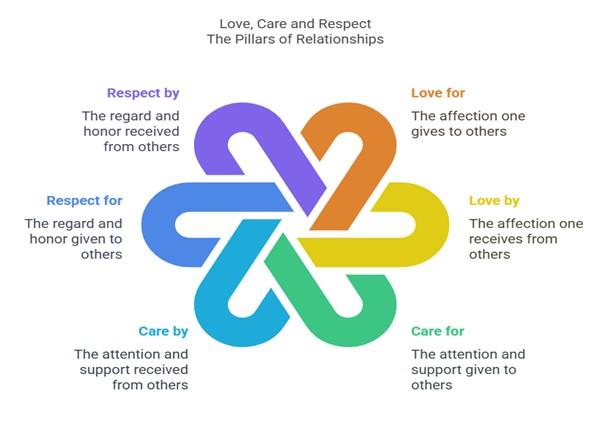
In the book Children and the Capability Approach (2011), Mario Biggeri and Santosh Mehrotra offer a list of domains selected by the children of Nepal, with the list going back to September of 2008. In this list, ‘love and care’, and ‘respect’ are categorized as two separate domains per the selection of the children. While our research utilizes these domains as well, it does so as one single domain. Focusing on this intersection of ‘love, care and respect’, this blog explores how children in Nepal actualize opportunities to be valued, while examining how they, in turn, extend these virtues to others. When quantified, the examples offered by students regarding being loved, cared for, and respected show that expressions of love accounted for 24 distinct examples, care for 18, and respect for 9. Notably, instances of children having ‘love and care for’ others outnumbered their experiences of being ‘loved and cared for’ by others.
Interestingly, the boys who participated in the discussion gave more examples for having reasoned values to care for others, while the girls had better reasoned examples of having love for others, and the respective dimensions were scored almost equally. Both boys and girls have love for their younger ones, their friends, themselves, and everyone in general. They reasoned to value having respect for their elders, and showed the importance of valuing and equally treating everyone with respect. They showed concern for the differently abled people, the elderly and younger ones, and valued caring for them. In addition, they also valued caring for the sick and ill people. They were vocal on their expectation of wanting to be loved, cared for and respected by their elders and teachers. The boys were also more concerned about the ones in need and difficulties, the ill and the sick, and they reasoned to value cooperation for social harmony, while the girls were more concerned about parents, siblings, and valued self-care, responsibilities, and no discrimination and inequality.
After completing these field activities that helped harness the indicators to evaluate children’s well-being, a baseline survey was then conducted (which included the operationalization of a survey as a diagnosis tool derived from FGD based indicators) in February of 2025, which provided more insight into the nuances of children’s evaluation of ‘love, care and respect’. The survey results showed that while the indicators for ‘love, care and respect’ cluster at high averages, these figures represent the internal stability of the child’s environment rather than their active capabilities. The findings revealed a structural paradox within the lives of children, specifically a disconnect between their emotional sentiment and social agency. As children generally experience affection as a familiar, embedded state, a significant shift occurs when the metric moves from passive feeling to active participation. When children were asked to assess whether they can speak up when they require care, and if that speech leads to action, the scores dropped in a noticeable manner. This gap indicates that children feel valued without feeling responded to, and this tension echoes the distinction between internal states and enacted life. As Aristotle (Nicomachean Ethics) observed, it is possible to possess a virtue without the external conditions necessary to exercise it. Therefore, while the data suggests that children are emotionally equipped, they are also socially constrained, since feeling loved remains as an internal condition, and being heard requires a specific context of permission and consequence. A child might feel secure within a family or school yet remain functionally silent, possessing inner comfort while lacking outer influence. This noticeable drop in scores when children were asked about ‘speaking up’ highlights a critical capability failure. It shows that while the functioning of being loved is present, the capability to exert agency is blocked. They possess the internal state, but lack the external ‘un-freedom’ from social restraint.
This pattern also remained consistent across all relational spheres. Parents scored highest in providing affection, yet the ability to voice a need scored lower than the feeling of being loved, and this disparity widened with teachers, elders, and peers. In the case of peer groups, uncertainty emerged where children felt the affection from their friends but hesitated to trust that voicing a personal need would result in a meaningful response. Out of all three, respect showed the steepest decline, with children reporting feeling respected as a sentiment, but fewer believing that expressing a concern would result in respectful treatment. Thus, we can observe that respect exists as a quiet feeling rather than a practical social exchange. Arendt (1958) has provided a lens for this struggle, arguing that true action requires a public space where speech can appear without fear. So while love can exist privately without challenging the status quo, voice introduces friction and demands a response. Currently, institutions succeed in cultivating care but struggle to sustain spaces where children can disturb the peace with a complaint. Speaking up carries the risk of disapproval, whereas feeling loved requires no such risk, and consequently, many children grow up surrounded by affection while practicing a habit of restraint.
The data collected from both the FGDs and the survey results highlights that children rate the care and respect they extend to others higher than what they received in their own lives. Their moral awareness outpaced the responsiveness of the adult world, and this matters because wellbeing includes social relevance and the ability to shape a shared life, with individuals, regardless of age, acting as active participants in their own lives. While feeling loved shelters a child, being heard positions them as an active participant in the world. This disparity between their internal sentiment and external agency suggests that while current educational and familial structures in Bhojpur Municipality provide emotional ‘shelter’, they also are inadvertently creating an environment of ‘functional silence’. While the high averages for love and care indicate stable internal environments, the decline in scores when asked about ‘speaking up’ reveals that children lack the public space necessary for true action. Therefore, a shift in social contexts is needed where a child’s voice carries consequence and their agency is recognized as the ultimate end of development.
NOTE: This blog is an output of the project titled ‘Promoting Gender Equality and Social Inclusion in Schools: Building on What Children Value and Aspire to Do and Be’, funded by the Global Partnership for Education’s (GPE) Knowledge and Innovation Exchange (KIX) and the International Development Research Centre (IDRC).
References:
● Arendt, H. (1958). The human condition. University of Chicago Press.
● Biggeri, M., Libanora, R., Mariani, S., & Menchini, L. (2006). Children Conceptualizing their Capabilities: Results of a Survey Conducted during the First Children’s World Congress on Child Labour. Journal of Human Development and Capabilities. 7. 59-83. 10.1080/14649880500501179.
● Biggeri, M., Ballet, J., & Comim, F. (2011). Children and the Capability Approach. In Palgrave Macmillan UK eBooks. Palgrave Macmillan. https://doi.org/10.1057/9780230308374
● Robeyns, Ingrid (2003a) Book review of Clark (2002). Ethics and Economics 1 (1).
● Robeyns, Ingrid (2003b) Sen’s capability approach and gender inequality: selecting relevant capabilities. Feminist Economics 9 (2/3): 61-92.
● Sen, A. (1999). Development as freedom. Oxford University Press.