Ensuring that children, irrespective of their abilities, socio-economic backgrounds, or gender, deserve the opportunity to learn, participate, and have their voices heard in a safe and equitable school environment is central to the attainment of Gender Equality and Social Inclusion (GESI). Community schools in Nepal aim to reduce educational disparities by collaborating between schools, families, and communities (Kumar, 2025). Despite these efforts, children, especially those with disabilities and from marginalized groups, continue to face inequalities that restrict their access to participation and quality education.
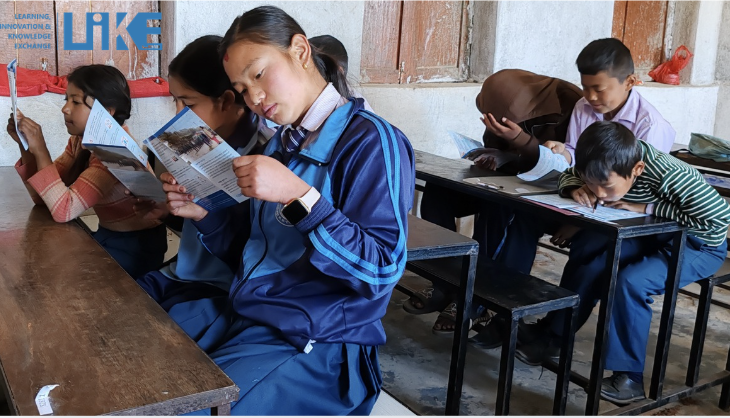
In an effort to address educational barriers, community schools are supporting interventions like student-led child clubs. These clubs, similar to after-school programs, provide safe and inclusive spaces where children can learn, play, and collaborate with their peers. By participating, children who might otherwise be excluded gain opportunities to build skills, express themselves, and develop confidence (Warren et al., 2009, as cited in Kumar, 2025). To expand the positive impacts of such interventions, they need to reach more schools and communities, raising an important question: what happens when these interventions begin to scale?
Scaling refers to a systematic, principle-based science to optimize benefits and raise the possibility that innovations will benefit society (Price-Kelly et al., 2020). It’s about understanding how proven ideas can expand their reach while remaining relevant and effective over time. This approach is especially important for achieving Sustainable Development Goal 4, which aims to provide inclusive, equitable quality education and lifelong learning opportunities for all (Fulgence, 2024). However, scaling up educational innovations is widely perceived to be a complex task. This is because schools differ in terms of resources, leadership, institutional capacity, and socio-cultural dynamics, which together influence how an intervention is implemented and sustained. Moreover, as interventions expand across diverse schools, maintaining the level of institutional integration, participation, and inclusion becomes increasingly challenging, particularly for marginalized groups who often face greater structural and contextual barriers to participation and inclusion. These concerns highlight the need to pay close attention to how scaling operates in practice, especially in the early stages of implementation, when essential patterns of adaptation, uncertainty, and variation across contexts begin to emerge.
Thus, this blog draws on six months of early implementation insights derived from the Learning, Innovation, and Knowledge Exchange (LIKE) Club, which is a student-led platform operating presently across 13 community schools in Bhojpur Municipality, Bhojpur District, Koshi Province, Nepal. The club creates safe and supportive spaces where children can participate, organize activities, and express their aspirations, and it functions not merely as an extracurricular activity but as a structured space where students actively engage in dialogue, decision-making, and collective action to advance inclusion and well-being. As an effort of the project “Promoting Gender Equality and Social Inclusion (GESI) in Schools: Building on What Children Value and Aspire to Do and Be,” it also contributes to examining scalability in expanding children’s valued educational capabilities (CVEC) through a GESI diagnostic tool while strengthening the capacities of students, teachers, and local stakeholders to foster more inclusive school environments.
Using insights gathered from the LIKE Club’s activity record book, where activities are designed to promote 16 children’s well-being indicators such as mental health and social relationships and autonomy, among others, and from documentation by Gender Equality and Social Inclusion (GESI) focal persons (a supportive teacher mentor, usually the social studies teacher at the school), this blog presents early implementation insights from 13 community schools over a six-month period. It examines how activities were carried out in practice, what these records reveal about student participation and variation in activity implementation across schools, and the practical implications for strengthening scaling efforts.
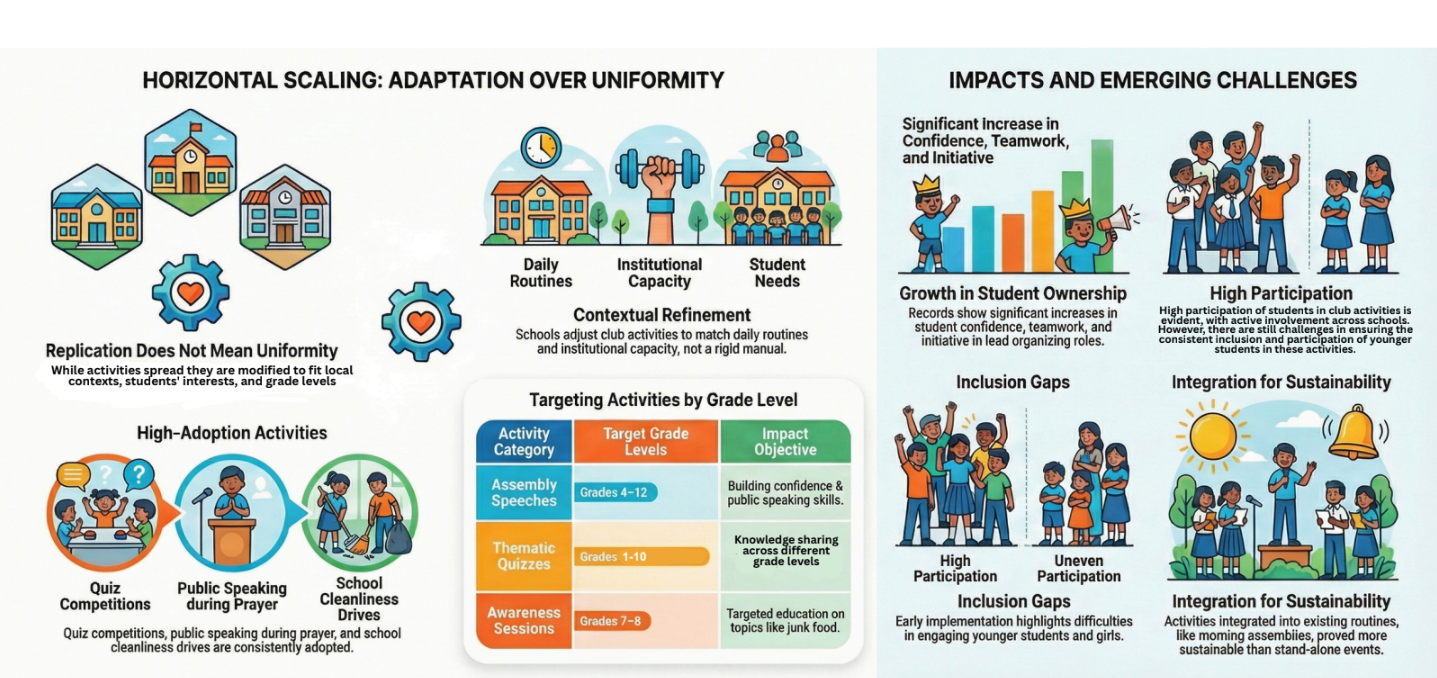
Replication Does Not Mean Uniformity: What Activity Books and GESI focal Records Reveal
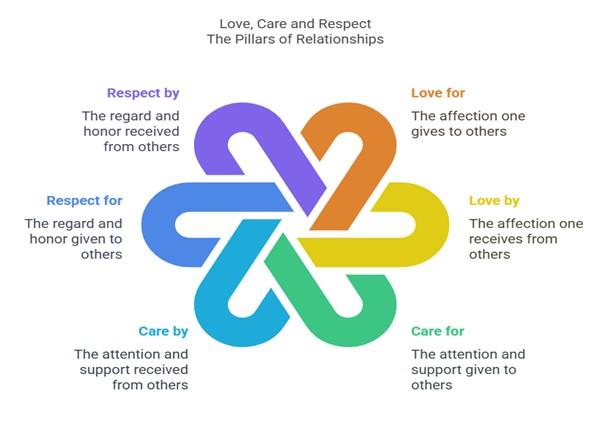
The LIKE Club activity records reveal a critical insight about scaling: activities are spreading across schools (replication) but not in exactly the same form (non-uniformity). A review of these records, where each of the 16 capabilities has been primarily filled by club members, shows that scaling is initially occurring through the replication of a common set of activities across schools, yet the way these activities are implemented varies according to the school’s context, grade levels, student interests, and available resources. Activities such as quiz competitions, public speaking, and speech sessions during prayer time appear repeatedly across multiple entries. Similarly, school cleanliness drives, waste management, plantation activities, and exercises focused on respect, care, and social relationships are consistently documented. At the same time, the records also capture other activities being conducted in some schools, including football competitions, dance programs, educational trips, creative arts programs such as singing and dance contests, and junk food awareness sessions.
Further analysis of the activity record sheet shows how thoughtfully schools are adapting the club activities to suit students in different grades. For example, during assembly speeches, students from grades 4–12 take the stage for 5–15 minutes, sharing ideas and voicing their opinions on different topics in front of their classmates, which helps them build confidence and public speaking skills. Meanwhile, quizzes and public speaking competitions are implemented across schools, with variation in the grade levels participating. In contrast, awareness activities, such as junk food prohibition initiatives focused on nutritional well-being, are primarily conducted among students in the upper grades, particularly those in grades 7–8. The records reveal important scaling insights: schools are not just replicating activities, but instead they are refining the club activities to fit the context of their school, students’ interests, daily routines, grade levels, and even the school’s institutional capacity. It points out that successful scaling happens when schools adjust activities to fit their context, instead of repeating it the same way everywhere. This pattern reflects “horizontal scaling” in practice, where a common set of activities is spreading across schools without being implemented in exactly the same way. Horizontal scaling aims for outward expansion by replicating successful interventions in additional schools and communities (GPE KIX, 2024). These early insights are important because they help identify which activities are consistently adopted and where variation is emerging, allowing for more intentional refinement of activities for future scaling efforts
The GESI focal person records reveal that children were highly engaged in club activities, demonstrating strong enthusiasm, curiosity, and active participation across schools. They also show that students developed confidence, teamwork, and a growing sense of ownership, often taking the lead in organizing activities. Over time, the records also point to positive behavioral changes, with students becoming more confident, expressive, and responsible. Together, these observations suggest that child clubs are emerging as effective spaces for both learning and personal development.
However, the records also highlight early challenges that affect scaling and sustainability. Inclusion remains uneven, with some difficulty in engaging younger students and girls in certain activities, as reported in the GESI focal records. It was also reported that GESI focal persons face challenges in adjusting club activities to fit the existing academic schedules and in conducting programs regularly, such as three times a week. In some cases, there is difficulty in ensuring equal participation of all students and in bringing younger children together for activities. Schools have also noted challenges in honoring winning groups who perform well in certain clubs’ activities due to the lack of prizes the school can offer to them. Despite this, practices such as increasing teacher involvement in guiding students for activity execution and integrating these activities into regular school routines, such as assemblies, are emerging as effective responses. These insights from the records suggest that scaling is not a uniform process but one that evolves differently across contexts. While child clubs are expanding, variations in participation, inclusion, and implementation highlight the need for flexibility rather than rigid replication.
Conclusion: What Early Insights Tell Us About Scaling
These early insights show that scaling is not a linear or predictable process but one that unfolds differently across diverse local contexts. While child clubs are expanding across schools, the level of participation, institutional integration, challenges to inclusion, and adaptation varies significantly. This reinforces the understanding that scaling involves more than just replicating proven outcomes across different contexts. It also requires flexibility to adapt to local conditions, institutional dynamics, and available resources.
At the same time, the findings point to several practical implications for strengthening scaling efforts:
- The records show that certain activities were repeated frequently across schools (e.g., quizzes and speeches in the school assemblies), while others were conducted only a few times (such as school-level exposure visits/field trips or awareness on child labor). and child reform). This implies that scaling should identify which activities are consistently adopted and assess whether less common activities need more targeted capacity-building support for execution.
- It was observed that certain activities such as speech or public speaking integrated into school routines like morning assemblies were more consistently implemented. This suggests that scaling efforts should align club activities with existing school structures to improve the sustainability of activities.
- The variation in how activities are implemented across schools demonstrates that flexibility is already a key feature of scaling. Rather than enforcing uniform models, scaling strategies should support guided adaptation, allowing schools to modify activities based on their context while maintaining core objectives.
- The activity records repeatedly highlight the need to provide prizes to club members who perform well in certain activities such as debates and speeches. They emphasize that this can help increase students’ motivation, encourage active participation, and support effective scaling of club activities.
Taken together, these insights highlight the importance of the early stages of implementation, as they reveal patterns that shape how scaling evolves over time. Understanding these dynamics can help inform more responsive and inclusive approaches to scaling, ensuring that child-centered interventions do not lose their core purpose as they expand but instead continue to create meaningful opportunities for all children.
Note: This blog is an output of the project titled ‘Promoting Gender Equality and Social Inclusion in Schools: Building on What Children Value and Aspire to Do and Be,’ implemented by LIKE Lab, Kathmandu University School of Arts, with support from the Global Partnership for Education and Innovation Exchange (GPE KIX) and the International Development Research Centre (IDRC).
Disclaimer: The views and opinions expressed herein do not necessarily represent those of the International Development Research Centre (IDRC) or its Board of Governors.
Author: Utkrishta Sharma, Junior Researcher, LIKE lab
References:
Fulgence, K. (2024). Scaling Education Innovations in Tanzania, Kenya, and Zambia: Assessing the Design of School In-service Teacher Training. In The Sustainability of Higher Education in Sub-Saharan Africa: Quality Assurance Perspectives (pp. 193-221). Springer Nature Switzerland. https://doi.org/10.1007/978-3-031-46242-9_9
Kumar, V. K. P. D. V. (2025). Education and Social Inequality: Bridging the Gap in Access and Opportunities for Marginalized Communities. Scholar’s Digest: Journal of Humanities & Social Science Studies, 1(1), 144-163.
Price-Kelly, H., van Haeren, L., & McLean, R. (2020). Scaling playbook: a practical guide for researchers.
Global Partnership for Education Knowledge and Innovation Exchange (GPE KIX). (2024). Scaling the impact of gender-responsive education models. International Development Research Center. https://www.gpekix.org/sites/default/files/2024-12/KIX%20GEI%20Scaling%20Brief%20FINAL.pdf