Call for Papers
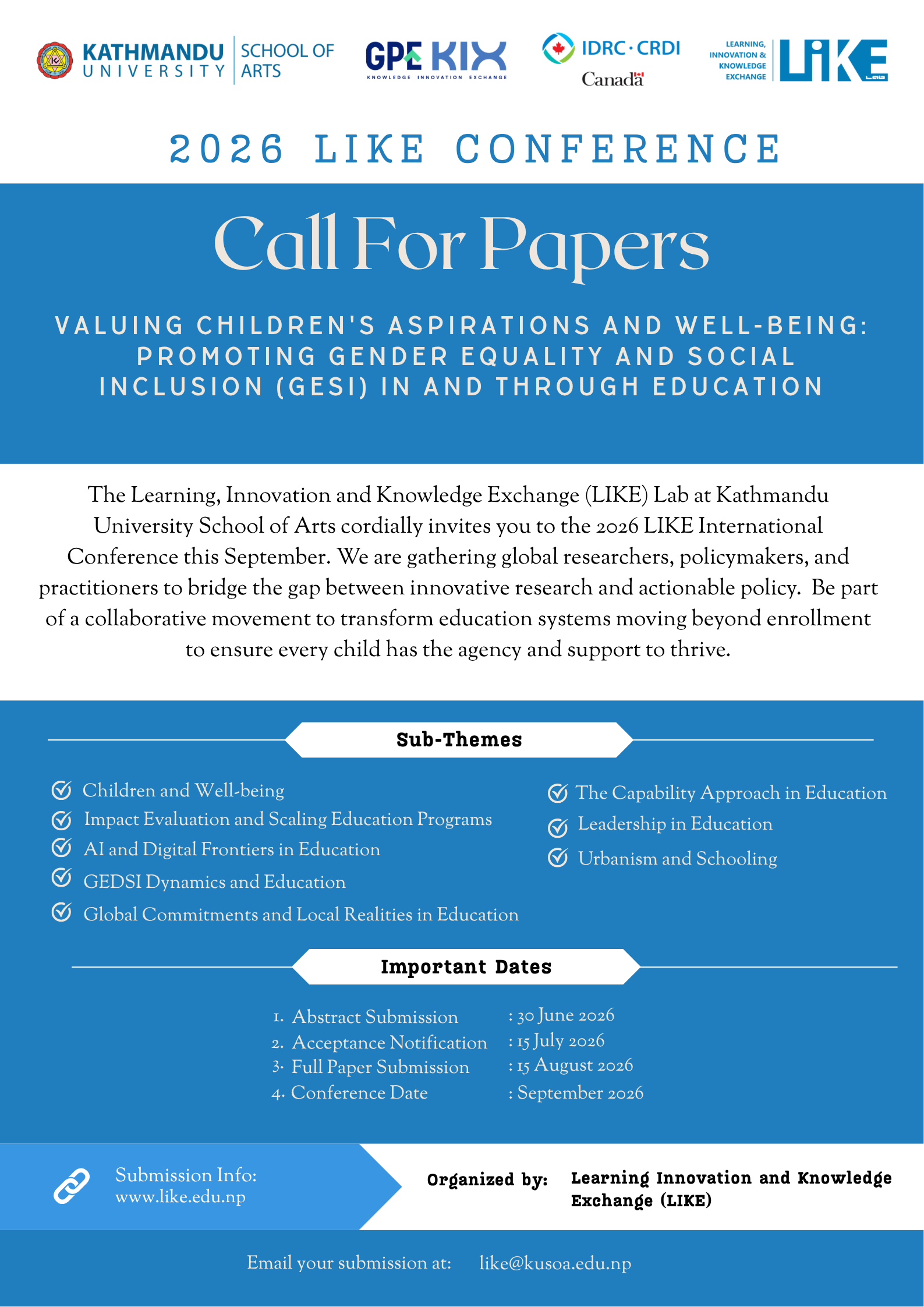
Valuing Children’s Aspirations and Well-being: Promoting Gender Equality and Social Inclusion (GESI) In and Through Education
Learning, Innovation and Knowledge Exchange (LIKE), a social science lab at Kathmandu University School of Arts, is focused on learning through participation, collaboration, and developing social innovations by adopting research for development in addressing educational issues. With the aim of social transformation at the core, the lab engages with academics, researchers, policymakers, and development practitioners to craft effective, scalable, and sustainable solutions. At present, LIKE is focused on delivering inclusive and scalable solutions to enhance access and learning outcomes in education.
With the support of the Global Partnership for Education Knowledge and Innovation Exchange (GPE KIX) and International Development Research Center (IDRC), LIKE is delighted to host this international conference in Nepal.
Conference Overview
- Objective: To foster global dialogue translating innovative research into actionable, inclusive policies for resilient education systems.
- Date: September 2026
- Time: 8:00 am – 5:00 pm
- Mode: In-person
- Working Language: English
- Format: Keynote speeches, parallel tracks, panel discussions, paper/poster presentations, and networking.
Conference Themes
The conference encompasses eight tracks under the following thematic areas:
- Children and Well-Being: Focuses on creating learning environments where every child, regardless of background or ability, is safe and supported. It moves beyond simple enrollment to address holistic needs integrating mental health, nutrition, and protection to transition rigid structures into flexible ecosystems that adapt to the developmental requirements of every learner.
- Impact Evaluation and Scaling Education Programs: The landscape of educational innovation is vast, but not all interventions yield meaningful results. This theme emphasizes the necessity of rigorous Impact Evaluation to distinguish between high-performing programs and those that fail to move the needle. By assessing effectiveness and efficiency, stakeholders can determine which “pilot” projects possess the systemic robustness to be scaled from a few classrooms to an entire national curriculum.
- AI and Digital Frontiers in Education: While ICT laid the groundwork, Artificial Intelligence represents the new frontier for personalized learning and administrative support. However, in developing contexts, the digital divide remains a critical barrier. This theme explores whether AI is bridging gaps or widening them, addressing essential infrastructure like electricity and connectivity. We specifically encourage submissions exploring the ethical implications of algorithmic bias and data privacy within the Global South.
- GEDSI Dynamics and Education: Gender Equality, Disability, and Social Inclusion (GEDSI) are central to achieving global development targets. This pillar examines how systemic barriers, such as rigid gender norms, physical inaccessibility, and ethnic discrimination, hinder learning. It advocates for transformative strategies that go beyond mere representation, ensuring that marginalized students have the agency, resources, and institutional support necessary to thrive within an inclusive and equitable classroom environment.
- Global Commitments and Local Realities: While international frameworks like SDGs set ambitious targets for quality education, the “last mile” of implementation often hits the friction of local realities. This theme explores the tension between top-down global mandates and bottom-up constraints, such as limited infrastructure, linguistic diversity, and economic instability. Success lies in “glocalization”, translating high-level commitments into actionable, culturally relevant policies that resonate with the community’s immediate needs.
- The Capability Approach in Education: This theme explores theoretical frameworks that prioritize a child’s well-being and agency over traditional standardized metrics. Rather than focusing solely on test scores, the Capability Approach evaluates education based on what students are actually able to do and be. It shifts the focus toward empowering children to lead lives they value, fostering critical thinking, autonomy, and the freedom to pursue diverse personal and professional paths.
- Leadership in Education: Empowering students to take charge of their own environments is vital for sustainable change. This theme highlights the role of “LIKE Clubs” and other student-led initiatives in fostering inclusive, safe, and empowered learning spaces. By centering child-led participation, schools can move toward a model where students are not just passive recipients of knowledge, but active leaders who contribute to school governance and community-wide social advocacy.
- Urbanism and Schooling: As global populations shift toward cities, the “urban advantage” in education is often undermined by rapid, unplanned growth and rising inequality. This theme explores the unique challenges of schooling in dense urban environments, including the growth of informal settlements, the privatization of education, and the spatial barriers to safe access. We invite research on how urban planning can better integrate schools as community hubs and how city-specific dynamics—such as migration, pollution, and high-cost living—shape the aspirations and well-being of urban children.
Important Dates & Registration
Abstract Submission Deadline: 30 June 2026.
Acceptance Notification: 15 July 2026.
Full Paper Submission: 15 August 2026.
Registration Fees:
- Student Presenters: Fee waived
- NGOs: NRs 3000
- INGOs: NRs 5000
- International Presenter: USD 150
Submission & Style Guidelines
Presenters must submit an abstract (250–300 words) in English. Abstracts should be submitted only once and can be accepted for either poster or oral presentations. Observers should RSVP at like@kusoa.edu.np.
Abstract Formatting
- Font: Times New Roman, Size 12
- Spacing: 1.5 line spacing; 1-inch margins on all sides
- Citation Style: APA 7th edition
Oral Presentation Requirements
- Font: Sans-serif (e.g., Arial), at least 22 pt
- Content: Maximum 30 words per slide
- Structure: Title, Introduction (1-2 slides), Methods (1-2), Results (2-3), Conclusions (1-2), References/Acknowledgements (1)
Poster Requirements
- Dimensions: Max 24″ W x 36″ H (61 cm x 91.4 cm)
- Legibility: Must be readable from 6 feet (suggested: Arial, 28 pt)
- Design: Colored poster